
A Hawk Over Fifth Avenue
SpaceX, Anthropic, Carol Bove, and two competing visions for New York's future, plus a hawk over Central Park and a tenth year in the RealTrends rankings.
Contents
The View: from my listing at 923 Fifth Ave, on the corner of 73rd St. Central Park unfolds below, with The Beresford rising beyond the treetops. Look closely and you’ll spot a bird just to the left of the building. Moments later, it was flying directly toward us.
A few things I’ve been thinking about this week.
The Hawk
A small New York moment above Central Park

A red-tailed hawk, making its rounds above Central Park. I captured this from a balcony of on Fifth Avenue. The eventual winning bidder witnessed every pass..
The view from my listing on the 15th floor of 923 Fifth Avenue is extraordinary on its own.
It was a crisp June morning with Central Park unfolding below in every shade of green. Most eyes are naturally drawn to the park, the skyline beyond, and the architectural icons that frame the view.
But this week, without warning, a red-tailed hawk emerged from the canopy below and flew directly toward the balcony, close enough for us to see every detail of its wings before it banked sharply over the park and landed on a nearby rooftop.
Then it returned.
And then again.
Each pass left us equally awestruck. The speed. The precision. The confidence of a creature that seemed to regard Central Park, Fifth Avenue, and the Manhattan skyline as its own backyard.
Perhaps it was a descendant of Pale Male, the famous red-tailed hawk that nested right next door on Fifth Avenue. Perhaps not.
Manhattan’s parks are home to an astonishing amount of wildlife from red-tailed hawks and peregrine falcons to owls, turtles, foxes, and hundreds of migratory bird species. Yet seeing a hawk at eye level from a Fifth Avenue balcony still feels improbable.
The apartment received multiple offers, and the winning bidder happened to be standing on that balcony for every fly-by.
Whether the hawk had anything to do with the outcome remains unconfirmed.
The Next Wave of Wealth Creation
SpaceX, Anthropic, and NYC’s startup ecosystem
Few topics are generating more excitement among investors right now than the upcoming SpaceX IPO, scheduled for next week, and Anthropic’s recent confidential filing to go public. Together, they represent two of the defining themes of our era: artificial intelligence and advanced technology. At current private-market valuations, the two companies are collectively worth well over a trillion dollars, and their eventual public offerings are expected to be among the most consequential in recent market history.
Yet while the headlines tend to focus on a handful of high-profile companies, a quieter transformation is taking place beneath the surface.
The term “Silicon Alley” was coined in the 1990s to describe the cluster of technology companies around Flatiron and Union Square. Today, New York is home to more than 25,000 tech-enabled startups, over 2,000 AI companies, and approximately 1,200 venture capital firms.
The city’s tech ecosystem is valued at more than $600 billion, making it the second-largest startup hub in the United States after the Bay Area.
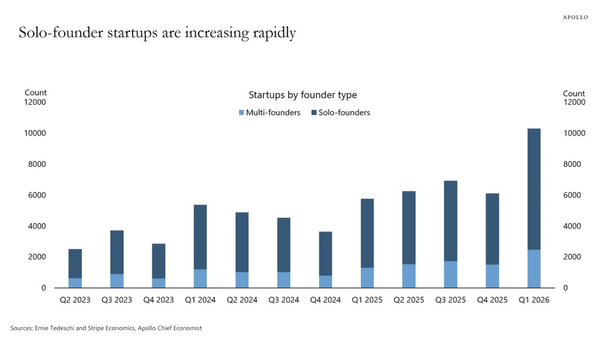
One chart (above) that caught my attention this week showed a sharp increase in startup formation. According to Apollo Chief Economist Torsten Sløk, solo founders are driving nearly all of that growth, a trend he believes may reflect how dramatically AI is lowering the barriers to building a company. If even a fraction of these startups succeed, the impact on employment and wealth creation could be substantial.
I see hints of this shift even within my own circle. Several friends of my children, now in their mid-20s, are founders of AI-enabled startups. What would once have required a small office, a team of employees, and substantial funding can now often be accomplished by a handful of people—and sometimes by a single founder.
Much of the investor excitement is focused on companies such as Anthropic and SpaceX. The anticipation surrounding their IPOs reflects a broader reality: some of the most significant wealth creation of the next decade is likely being built right now.
New York is one of the places where it is happening.
RealTrends 2026
Ranked among the nation’s top brokers for the tenth consecutive year
A note on rankings (since everyone is posting about them):
RealTrends released its annual rankings this week, and I was honored to be included once again—marking my tenth consecutive year among the top real estate professionals in New York City and across the country.
You’ll see the social posts. You may have already.
But rankings deserve context.
Some top-ranked agents represent production homebuilders. Others operate large teams, partnerships, or multi-city businesses. All are legitimate models. They are simply very different businesses.
I represent individual buyers and sellers in Manhattan and prime Brooklyn. Many of the transactions I handle involve co-op boards, estate sales, architecturally significant properties, private exclusives, and negotiations that require equal parts strategy, discretion, and persistence.
I know my clients by name and by story.
That’s what matters most to me.
At the Guggenheim: Carol Bove

Secondhand Damnation, 2023. Stainless steel and urethane paint.
I stopped by the Guggenheim with a friend this week and was struck by a series of sculptures that looked remarkably like draped fabric, until I learned they were made of steel.
The exhibition, by contemporary artist Carol Bove, transforms massive industrial materials into forms that appear unexpectedly soft and fluid. Walking through the galleries, we found ourselves repeatedly questioning what we were looking at. Rigid materials seemed almost pliable. I kept wanting to touch and feel each piece.
What interested me most was the tension it created between appearance and reality.
Cities often operate in much the same way. What appears permanent is constantly evolving. What looks effortless is usually the result of immense forces working beneath the surface.
Bove’s sculptures capture that contradiction beautifully.
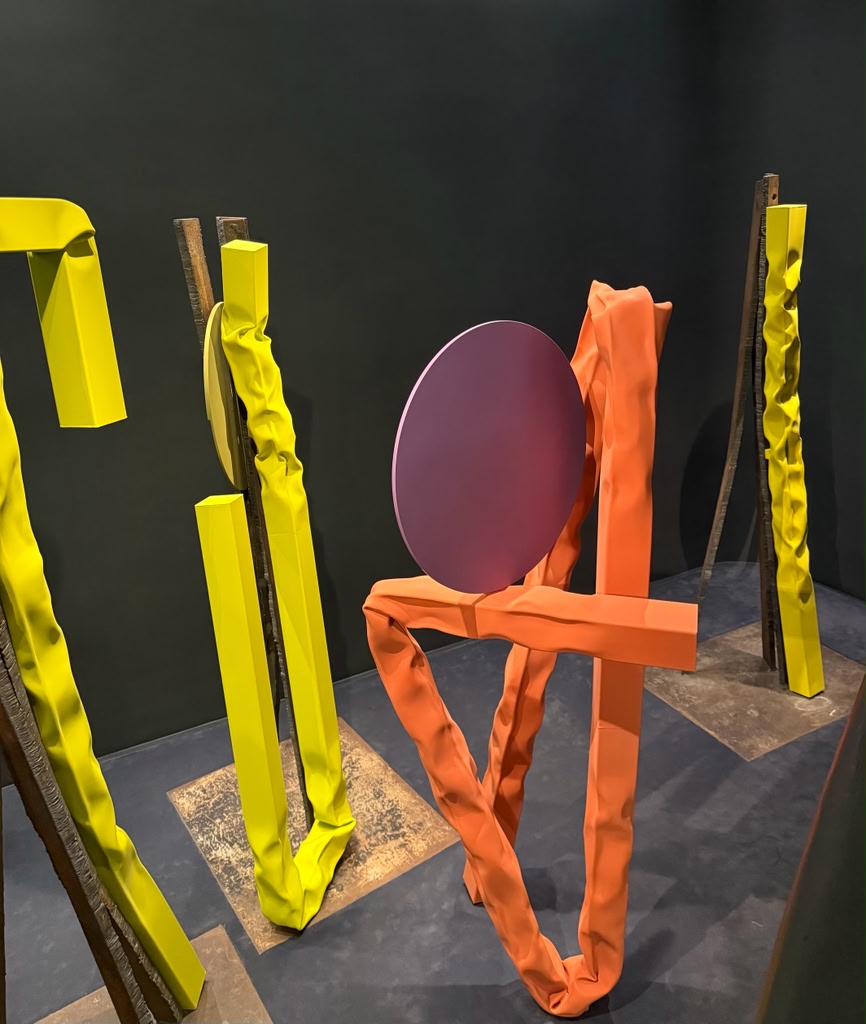
Sweet Charity, 2026 (Steel, Stainless Steel, Anodized Aluminium, and Urethane Paint)
These seven totemic forms represent the culmination of Bove’s “collage sculptures,” a body of work that has occupied a central place in her practice for the past decade. Conceived for this double-height gallery, the soaring sculptures entwine steel construction tubing with elongated shards of industrial steel plate. Bove has manipulated the tubes into undulating volumes and precisely coated their surfaces in layers of richly hued paint, lending the metal an unexpected sense of softness and plasticity. Large aluminum disks intersect these structures, hovering like celestial bodies amid a grove of vertical forms.
Despite their immense weight and intractable materials, the sculptures are imbued with an exuberant sense of movement, as if they were dancing in space. Bove’s installation expands on a group of her vertical collage sculptures from 2017 that invoke the Pleiades of Greek mythology-seven sisters, often depicted reveling together, who were transformed into a constellation of stars to escape Orion’s pursuit. A less exalted glamour is suggested by the title, a reference to Bob Fosse’s 1969 film Sweet Charity, which tells the story of a lovelorn New York City dance-hall hostess through bold imagery and stylized choreography.
Two Visions for New York’s Future
Along Billionaire’s Row
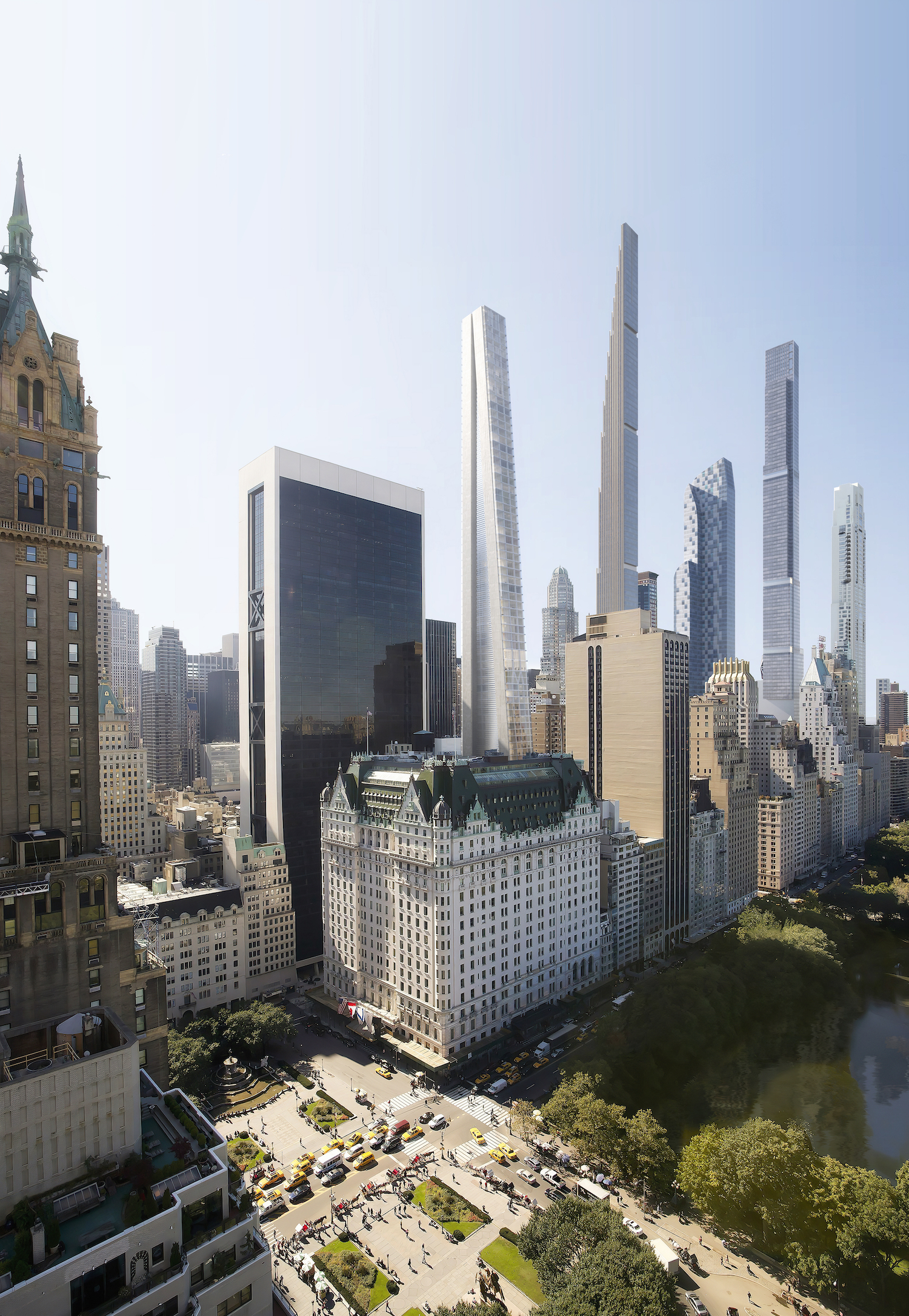
Rendering of 41-47 West 57th Street by OMA, shown here rising behind the Plaza.
A fascinating contrast is unfolding just steps apart on Billionaires’ Row.
One proposed development at 41–47 West 57th Street would add a 1,100-foot supertall containing just 119 ultra-luxury condominiums, with no affordable housing component. Designed by OMA, the tower would join the skyline-defining buildings that have transformed this stretch of Midtown over the past decade.
A few blocks away, a very different project is moving forward. The conversion of the former office building at 135 East 57th Street would create approximately 350 apartments, including 88 affordable units, by repurposing underutilized office space into housing.
What’s striking is that these projects are nearly the same size and sit within a short walk of one another. Yet they represent fundamentally different visions for New York’s future.
- One is designed for a relatively small number of ultra-high-net-worth buyers.
- The other seeks to create hundreds of homes while helping address the city’s housing shortage.
Neither project exists in a vacuum. New York needs investment, tax revenue, and the global capital that has long been drawn to its luxury market. It also needs more housing and creative solutions to a persistent affordability challenge.
Taken together, these developments offer a snapshot of the broader debate shaping the city today: how should NYC’s growth take shape, and who that growth should serve.
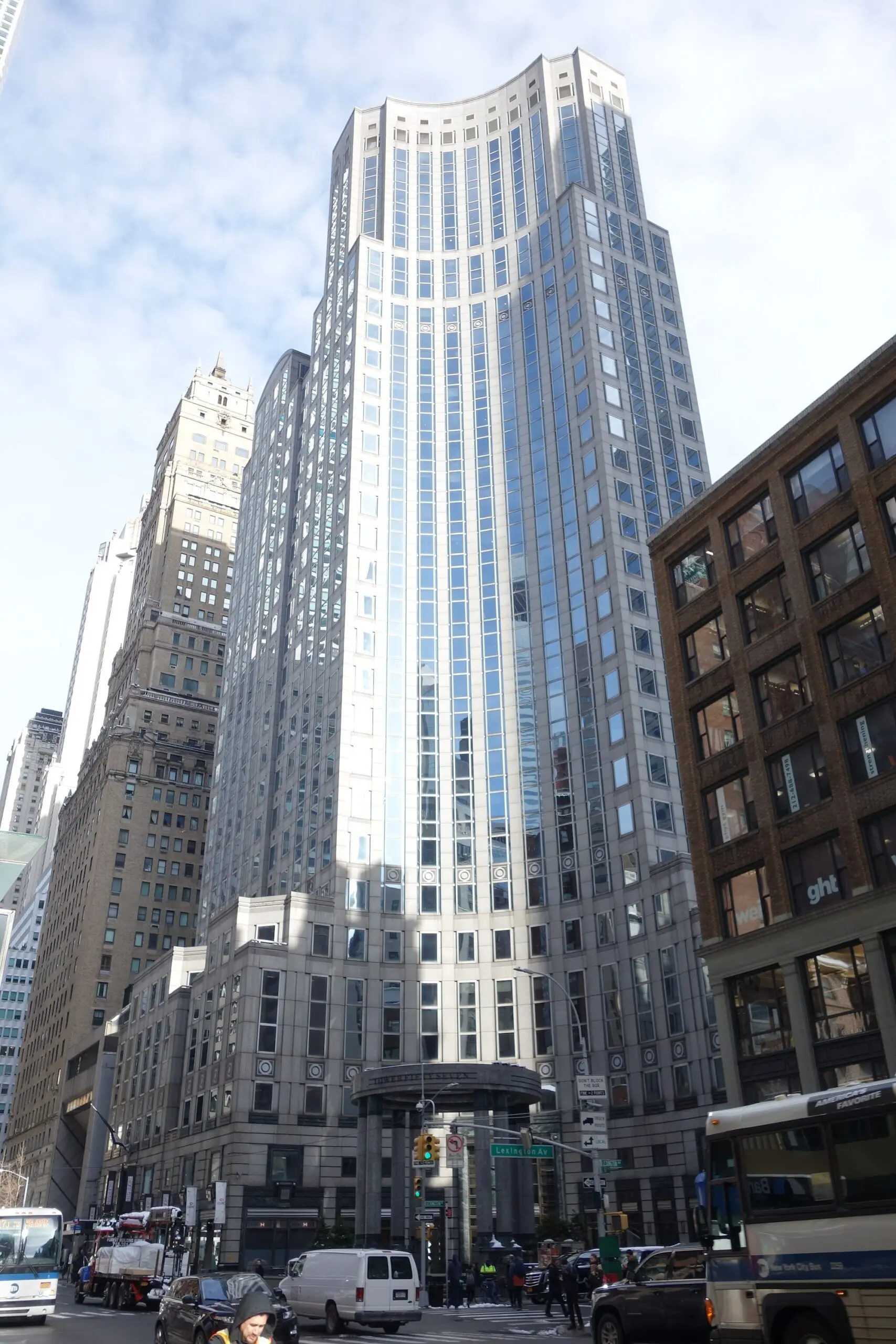
Tower 57 at 135 East 57th Street