
From Milan to Manhattan
A personal milestone of ten years of recognition, Milan's remarkable housing market, congestion pricing six months on, and what the latest Manhattan data reveal.

Contents
This week: A personal milestone, an unforgettable journey through Italy, and the forces shaping real estate from Manhattan to Milan.
A Personal Note

With the release of this year’s industry rankings, I was honored to once again be recognized among New York City’s leading real estate teams and among the top real estate professionals in Manhattan.
To be recognized year after year in one of the most competitive real estate markets in the world is both humbling and deeply meaningful. More meaningful still is what that recognition represents: ten consecutive years of sustained excellence, first as an individual agent, and now as the founder of The BAHAR Team.
This recognition is not simply about a single year. It reflects 10 years of earning the trust of remarkable clients in an extraordinarily competitive market.
To everyone who has entrusted me with one of life’s most important decisions, thank you. Your trust and confidence mean more than any ranking ever could.
It is a privilege I never take for granted.
From Milan to the Dolomites
Travel, architecture, and one of Europe’s strongest housing markets.
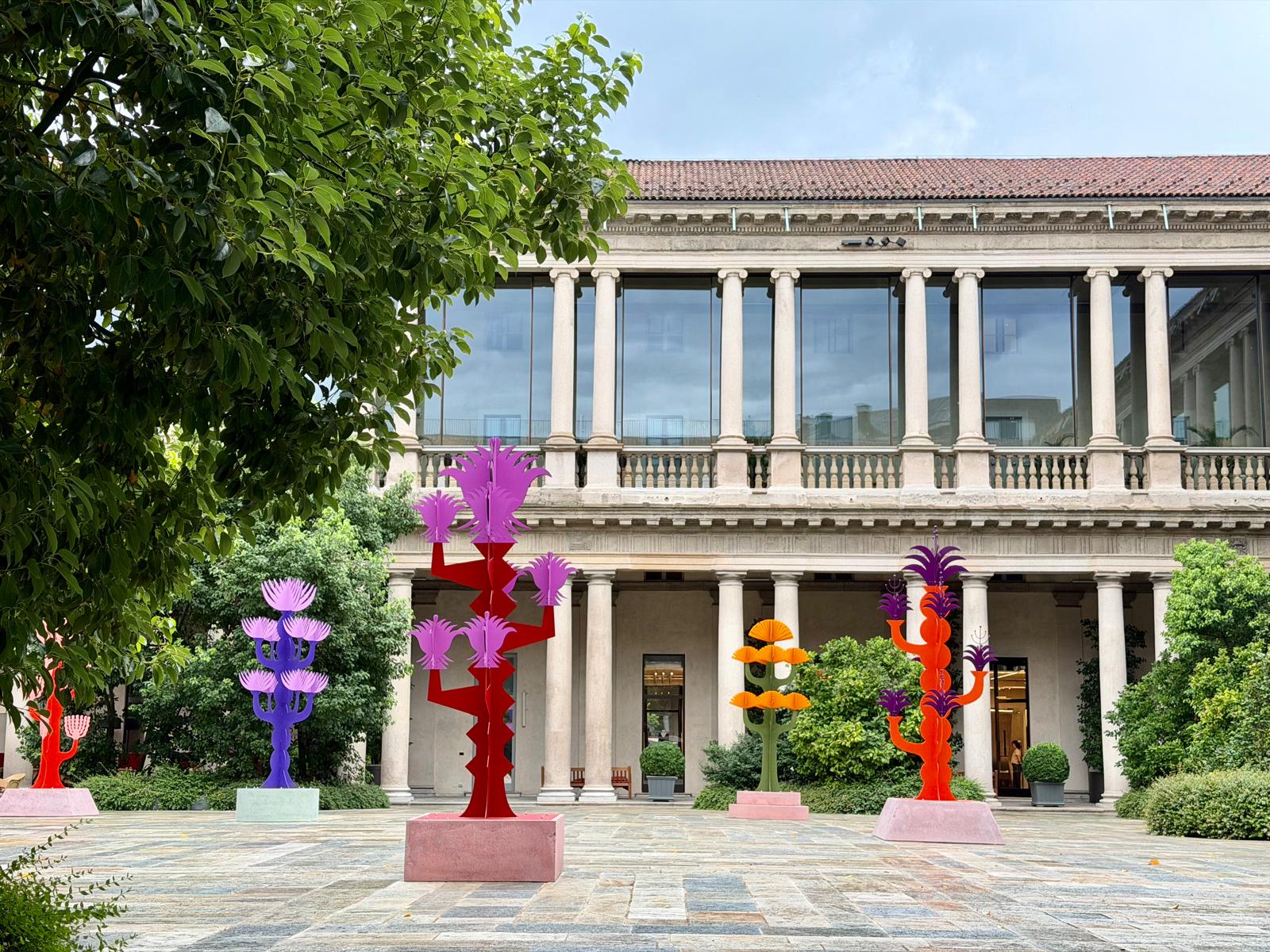
The historic courtyard of the stunning Portrait Milano, transformed during our visit by Agostino Iacurci’s vibrant installation, Arcipelago Botanico.
Our recent journey through Italy began in Milan, continued to the magical canals of Venice for a beautiful wedding, and ended in the breathtaking Dolomites, where every hike felt like walking through an exquisite painting.
As always, I found myself observing Milan through the lens of real estate.
Milan has quietly become one of Europe’s strongest housing markets.
Prime residential prices rose 7% year-over-year in the second quarter of 2025, outperforming every major European luxury market, including Paris, Monaco, Madrid, and Zurich.
Over the past five years, values in Milan’s prime residential market have increased approximately 38%, according to Knight Frank.
The city’s momentum extends well beyond local demand. International buyers, particularly from the United Kingdom, Sweden, and the Netherlands, continue to increase their presence, drawn by Milan’s growing role as a global financial and design capital, as well as Italy’s attractive flat-tax regime for wealthy foreign residents. This keeps coming up as the structural driver behind Milan’s luxury run.
The numbers are striking. Asking prices in Milan’s historic Centro now average approximately €11,300 per square meter, while Engel & Völkers estimates luxury residences generally trade between €10,000 and €23,000 per square meter, still well below comparable prime neighborhoods in central London.
Perhaps the most remarkable shift is how quickly Milan has closed the gap with Europe’s traditional financial capitals. A recent Financial Times analysis found that Milan’s mainstream housing market is now less affordable than London’s when measured against local incomes, which is a remarkable reversal from just a decade ago.
Forecasts suggest the city’s momentum is far from over. While residential prices across Italy are expected to rise approximately 4.2% in 2026, Milan is projected to lead the country with growth of roughly 7.3%, ahead of Rome.
For me, Milan reinforced a lesson that extends well beyond Italy. The world’s great cities never stand still. They continue investing in themselves, attracting talent and capital, and reinventing themselves for the future, while preserving what made them great in the first place.

Looking toward the Dolomites from Ortisei, the charming alpine town nestled in the heart of these magnificent mountains.
The New Rhythm of Manhattan
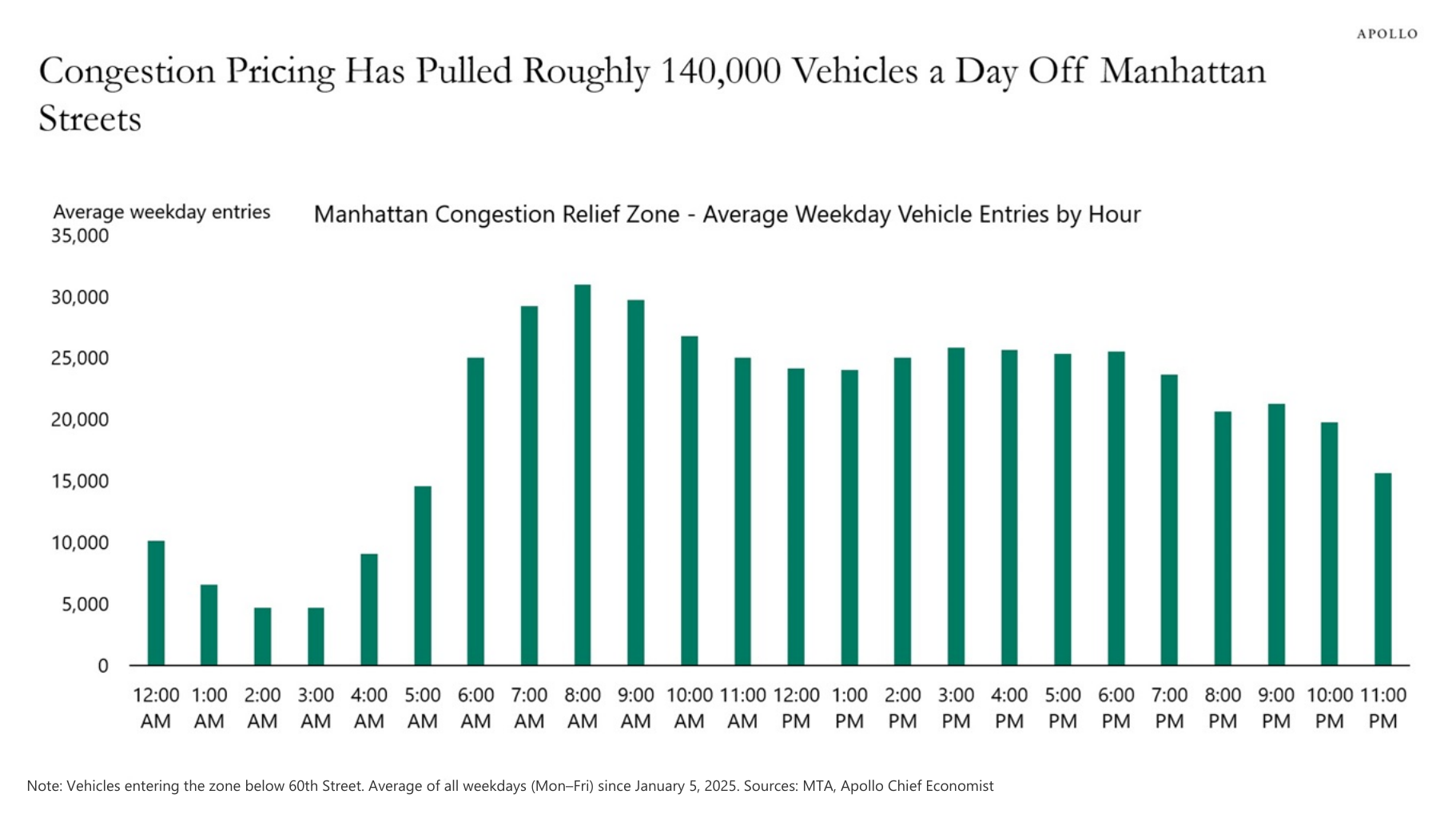
Vehicles entering the zone below 60th Street. Average of all weekdays (Mon–Fri) since January 5, 2025. Sources: MTA, Apollo.
Since congestion pricing launched in January 2025, roughly 500,000 vehicles enter Manhattan’s Congestion Relief Zone on a typical weekday. According to the MTA, daily entries have declined by approximately 13% from the pre-toll baseline of about 640,000 vehicles.
Traffic peaks around 8:00 a.m., when roughly 31,000 vehicles enter the zone, then remains remarkably steady throughout the day rather than surging again during the evening rush.
The data suggest a smoother flow of traffic and less pronounced rush-hour congestion in Manhattan’s busiest business district.
Manhattan Market Report
Every week I track supply, contracts, and momentum across Manhattan to better understand where market is headed. Here’s this week’s data, through Friday July 17th.
First of all: summer is traditionally a quieter season in Manhattan real estate, especially at the high end, as many residents travel or move to homes in the Hamptons, CT or elsewhere. This year is no exception. Many buyers and sellers are traveling, and transaction activity naturally slows.
But a seasonal slowdown is not the same as a weakening market.
The accompanying charts tell an interesting story. Taken together, they point to a market that is behaving much as one would expect in mid-summer: inventory has eased, transaction volume has moderated, and buyers have become increasingly selective. Yet demand for well-priced, high-quality properties remains intact.
Inventory
After a strong June, inventory has pulled back sharply in July—a seasonal pattern we often see as summer travel picks up.
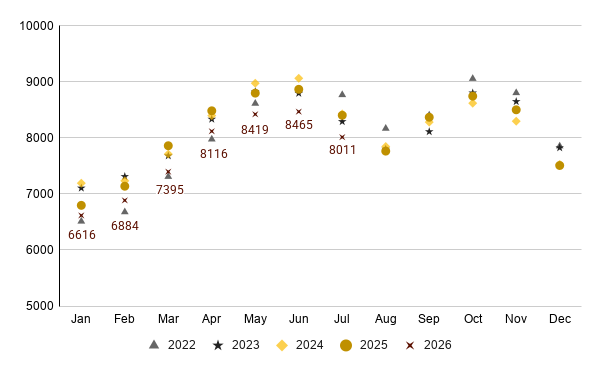
Total Supply — Average Inventory
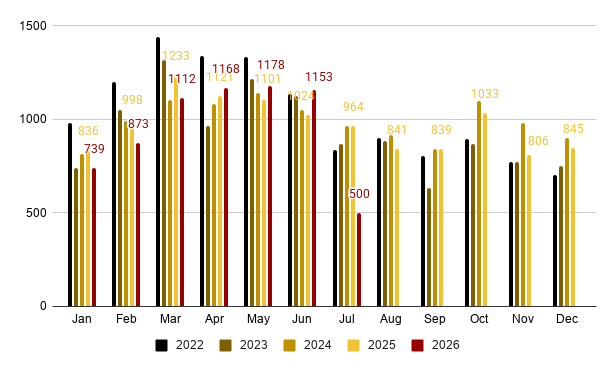
Overall Demand — Contracts Signed
Above $4M
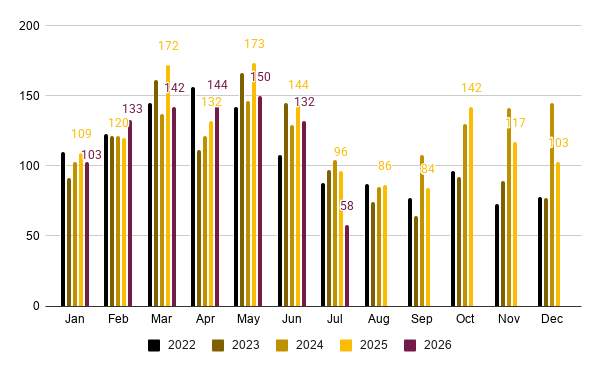
The charts through July 17 raise an interesting question: Is Manhattan’s luxury market losing momentum, or are we simply seeing the normal rhythm of summer? I believe it’s largely the latter.
Contracts signed above $4 million have moderated from the extraordinary pace earlier this year. Activity has slowed, but not in a way that looks out of step with a typical July, when vacations, school breaks, and travel naturally reduce transaction volume.
While some buyers are taking a more measured approach amid broader economic uncertainty, well-priced and well-presented properties continue to attract serious interest.
What we’re seeing is less a decline in demand than a market that has become increasingly selective.
Some international and second-home buyers are also keeping a close eye on the proposed pied-à-terre tax, though it has yet to materially alter purchasing decisions.
Luxury ($4M+) — Contracts Signed
Above $10M
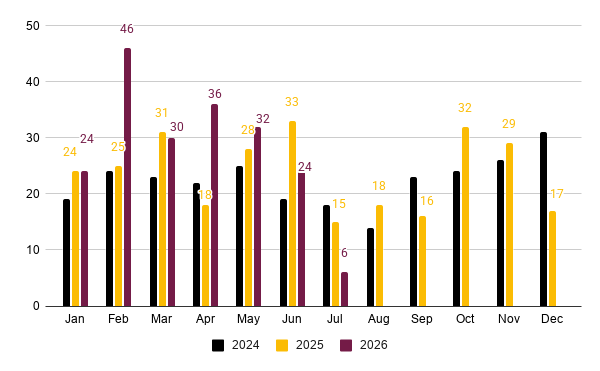
The chart below (through July 17) tells a similar story to the $4M+ segment. Weekly contracts remain healthy, though below the exceptional levels we saw this spring. Buyers remain active, but they are also increasingly discerning, particularly at the very top of the market where every purchase is highly discretionary.
Well-priced properties continue to trade, while aspirational pricing is meeting greater resistance.
For sellers, the lesson remains unchanged. Exceptional properties continue to command exceptional prices—but only when they are positioned correctly. Buyers today have unprecedented access to information and are willing to wait for the right opportunity.
The $10 million-plus market continues to be driven by a relatively small number of highly discretionary buyers. Weekly contract volume has moderated from the exceptional pace seen earlier this year, but activity remains healthy by historical standards.
At this level, pricing, rarity, and quality matter more than ever. Trophy properties continue to command attention, while buyers are taking more time evaluating opportunities before committing.
Ultra-Luxury ($10M+) — Contracts Signed