
New York, Dressed in Blue and Orange
The Knicks are NBA champions for the first time in 53 years, a market lesson from SpaceX and Hermès, an $80 million downtown contract, and the story of Grove Street.
Contents
They say New York never sleeps. And last night, no one wanted to. The Knicks are NBA champions for the first time in 53 years. New York didn’t just celebrate; it erupted. On every street corner, and in every park, restaurant and bar across the city, we were all one, sharing the same joy, excitement, and optimism. Last night, New York was one giant love letter to itself.
This week: 53 years. A market lesson from SpaceX. And $80 million moving downtown.
A New York Story
“Because greatness is rare. And the true greatness that is New York City is beyond rare.” — Jerry Seinfeld
Driving home from an early dinner in the East Village last night, rushing to catch the game, we witnessed an infectious energy on every corner of our beloved city.
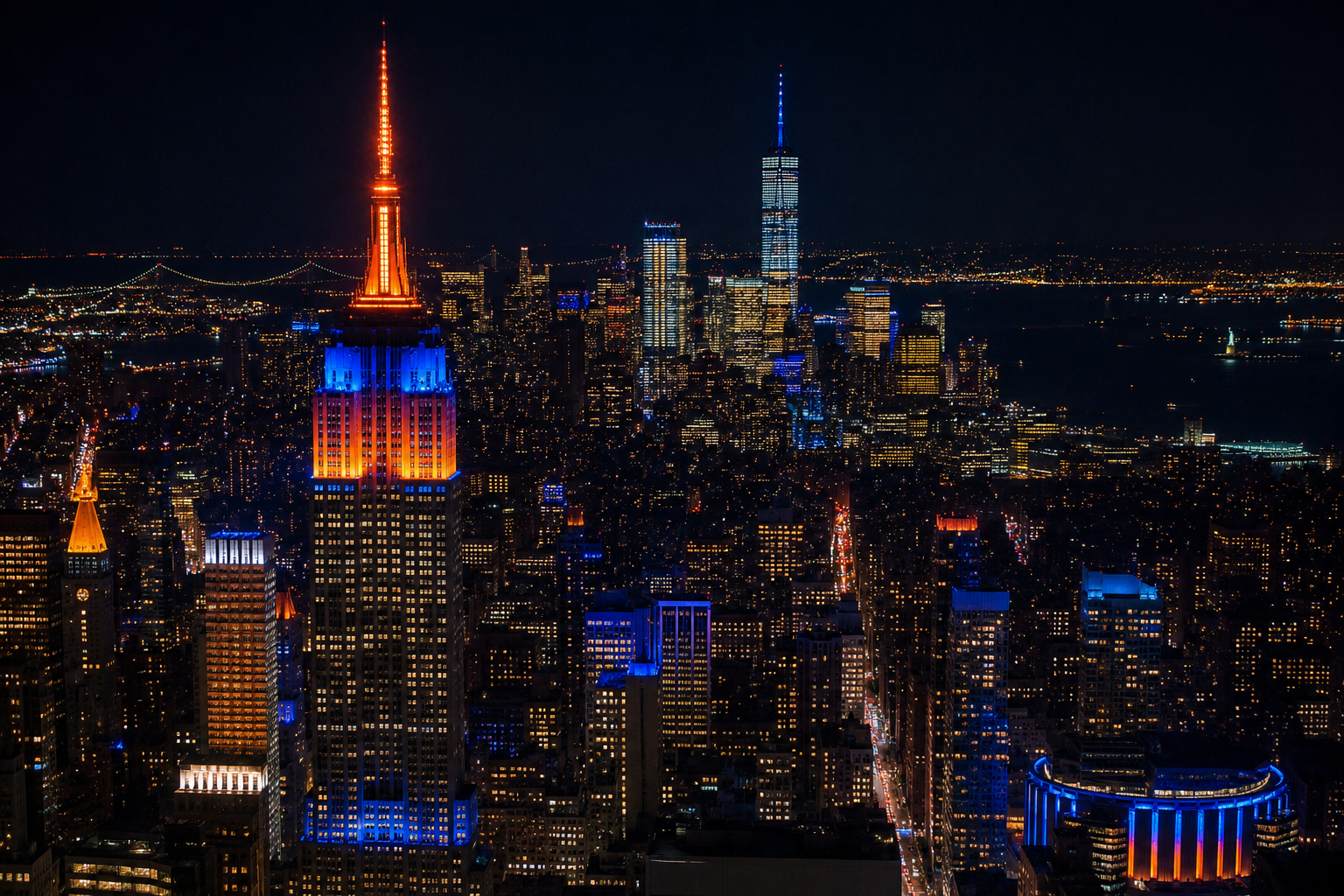
New York was dressed in blue and orange.
From the super-talls to the bodegas, the entire city was glowing in Knicks colors. Storefronts had the game on. Bars were overflowing. Sidewalks were packed. Everywhere we looked, it was about the game. The Knicks.
When the Knicks clinched the championship, the city erupted in a collective, euphoric celebration.
As I sat watching, emotion welling up and excitement overflowing, a beer commercial came on and captured the moment perfectly:
“The grit. The hustle. The heart.”
Because that’s what New Yorkers saw in this team. The refusal to quit. The willingness to outwork expectations. The belief that persistence matters.
Those qualities have always defined New York at its best. In many ways, this championship felt as much a New York story as a sports story.
We’re a city of dreamers, builders, risk-takers, strivers, and survivors. And we saw that reflected on the court.
This was us. This was New York.
Millions of New Yorkers sharing the same joy, the same excitement, and the same sense that they were witnessing something special.
And as the city celebrated long into the night, I couldn’t help but think that we were really celebrating something larger than a championship.
“The grit. The hustle. The heart.”
The Difference Between Price and Value
The SpaceX IPO on Friday got me thinking about something I encounter almost every day in real estate: the relationship between numbers and value.
How often have we heard some version of this question?
“They paid X for the apartment, spent Y renovating it, so why are they asking Z?”
It’s a perfectly reasonable question. After all, we’re taught to trust numbers. Yet some of the most important decisions we make—in investing, in business, and in real estate—are not governed by mathematics alone.
Consider the value of a home. Its assessed value is not its market value. A Zestimate is not its market value. What a seller paid for it five years ago is often not its market value. Those numbers may provide useful reference points, but none of them determine what a buyer is ultimately willing to pay.
The same principle extends well beyond real estate. An Hermès Birkin bag contains a certain amount of leather, hardware, craftsmanship, and labor. Yet no spreadsheet of material and manufacturing costs can fully explain why someone is willing to pay many times that amount to own one.
And then there is SpaceX. Is it worth the valuation investors assigned to it on Friday? Perhaps. Or perhaps investors are placing a value on something that does not yet exist: future technologies, future revenue streams, future discoveries, and future possibilities. The valuation reflects not only what the company is today, but what people believe it may become tomorrow.
Real estate is no different. Is an apartment with 12-foot ceilings worth more than one with 9-foot ceilings? Almost certainly. But how much more? Is a terrace directly off the living room worth the same as one reached by a staircase to the roof? Is a direct Central Park view worth twice as much as a city view? Three times as much? There is no equation that provides the answer.
This is because valuation and mathematics, while related, are fundamentally different disciplines. Mathematics deals in objective truths. Valuation incorporates scarcity, desirability, timing, emotion, expectations, and countless other variables that cannot be measured with absolute precision. Math provides the tools. Human judgment supplies the inputs.
The numbers matter. They always do. But value is often determined by something far less precise: what people desire, what they believe, and what they are willing to pay to own something scarce.
That is true of SpaceX. It is true of Hermès. And it is certainly true of Manhattan real estate.
The Billion-Dollar Building
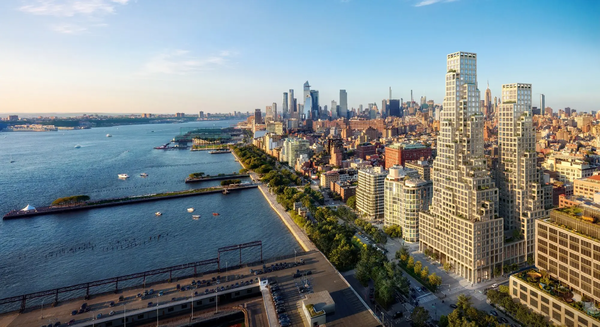
80 Clarkson, in the West Village, with its double towers overlooking the Hudson River.
One of Manhattan’s most closely watched developments reached another milestone this week.
A duplex penthouse at 80 Clarkson entered contract asking $80 million, making it one of the largest residential deals of the year and among the highest-priced transactions ever recorded downtown.
The timing is noteworthy. The contract comes just weeks after New York approved its new pied-à-terre tax, suggesting that concerns about the tax have done little to dampen demand among the world’s wealthiest buyers.
What makes 80 Clarkson particularly interesting is that it reflects a broader shift in Manhattan’s luxury market. For decades, the highest echelon of residential pricing was concentrated around Central Park and a handful of premier Upper East Side cooperatives. Increasingly, however, some of the city’s largest transactions are taking place downtown.
Developed by Zeckendorf Development and Atlas Capital Group and designed by COOKFOX Architects, 80 Clarkson has reportedly surpassed $1 billion in sales before completion. The project’s appeal goes beyond its waterfront location. With only 112 residences, it offers something increasingly difficult to find in Manhattan: true scarcity. Large-scale luxury development opportunities along the West Village waterfront are exceptionally rare and unlikely to be replicated anytime soon.
The success of 80 Clarkson also highlights an important trend at the very top of the market. Buyers are no longer paying simply for square footage or finishes. They are paying for privacy, discretion, architecture, and experiences that cannot easily be reproduced elsewhere.
For all the headlines about taxes, politics, and uncertainty, capital ultimately goes where people most want to live.
This week, one buyer made an $80 million statement about New York.
Grove Street, West Village
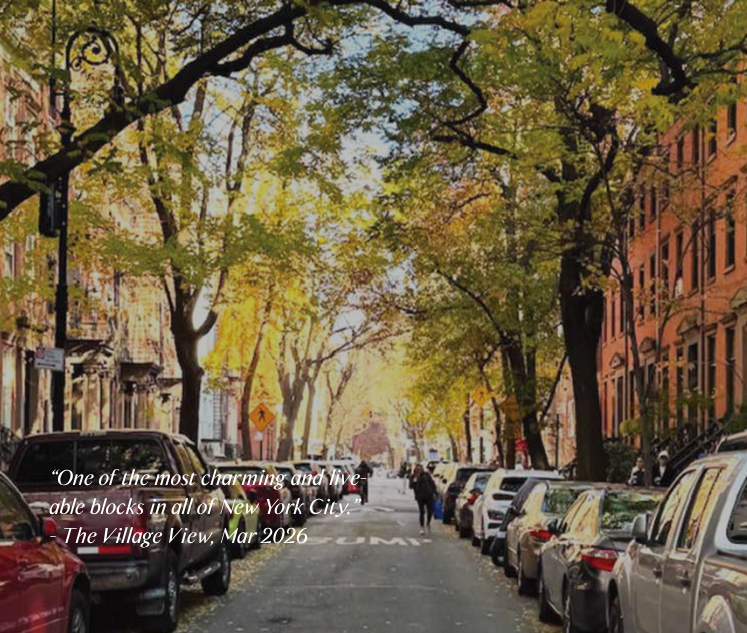
Grove Street, West Village
I have a beautiful listing at 2 Grove Street (details below), on the corner of Hudson. It’s a 1940 Art Deco co-op with an elevator, right in the heart of the West Village. Curious about the history of the street, I went down a rabbit hole.
Here’s the story of this little part of Manhattan:
Grove Street is one of those rare Manhattan blocks that feels like it belongs to another century, because much of it does. The name is no accident: it was given for the abundant greenery that lined the street, a wooded character it still holds today under its canopy of trees.
In 1799, it was little more than a dirt road through an apple and cherry orchard. At the time it was known as Columbia Street before eventually becoming Grove. At number 17, on the corner of Bedford, stands one of the oldest surviving houses in the Village, a rare wooden structure dating to the turn of the 19th century.
Tucked between numbers 10 and 12 is Grove Court, a hidden enclave of six townhouses set back behind a wrought iron gate, originally built in the 1850s to house the working class, today worth millions.
At the foot of the street sits Christopher Park, a small triangle bounded by Grove, West 4th, and Christopher Streets. Since 1992 it has been home to George Segal’s Gay Liberation sculptures, the first public monument in America commemorating the struggle for LGBTQ rights.
The restaurants have kept pace with the history: Via Carota, Buvette, Little Owl, and Bar Pisellino are all within steps.
Grove Street manages to feel both timeless and unmistakably New York.