
The New Pied-à-Terre Surcharge
A look at how New York continues to evolve — from population trends and tax policy to a visit to the Whitney Biennial and exceptional homes on and off the market.
Contents
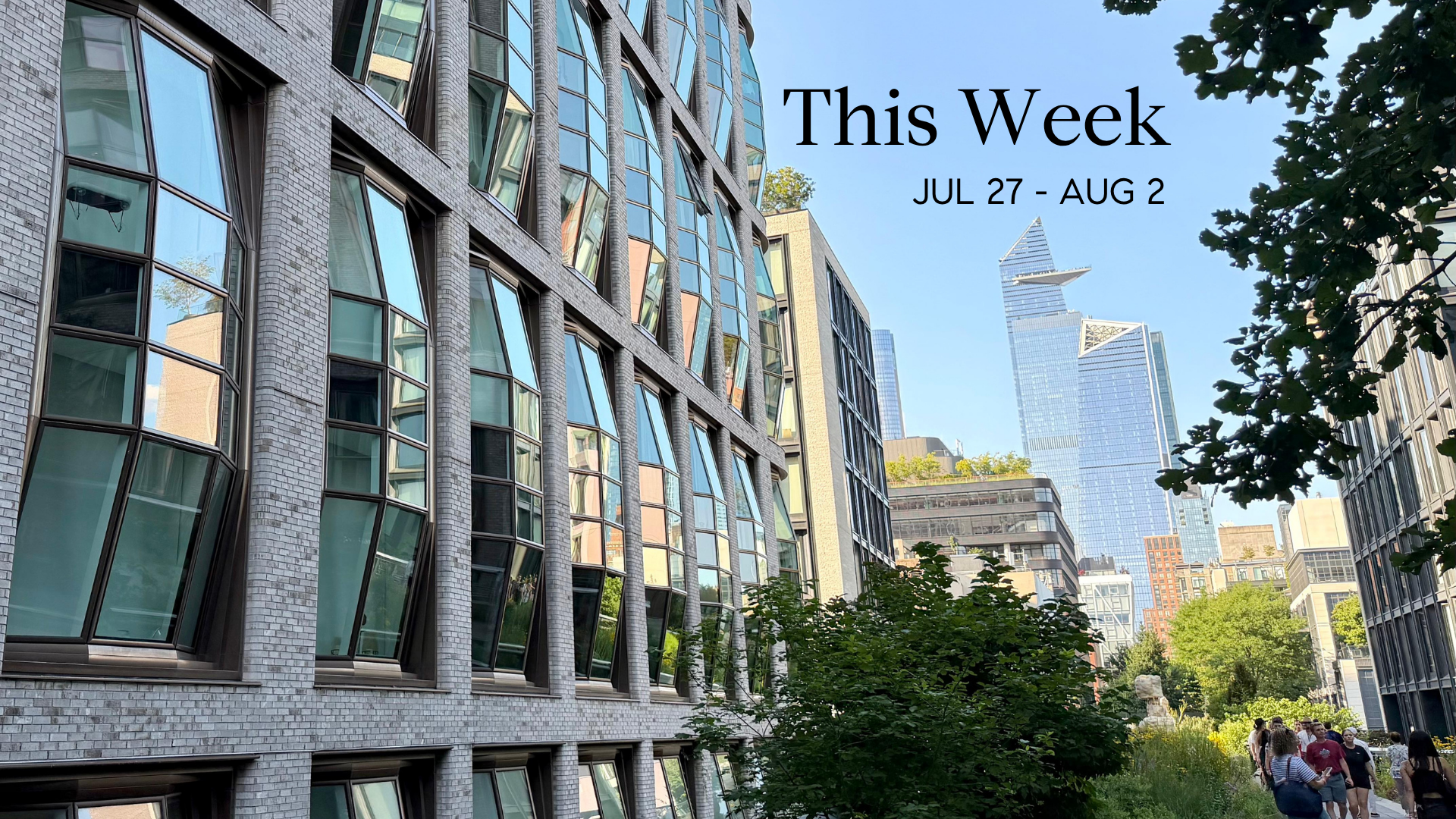
A walk on the High Line last week. To the left is Thomas Heatherwick’s Lantern House, while Hudson Yards rises in the distance, with The Edge prominently in view. A small glimpse of New York’s constantly evolving skyline.
This week, a look at how New York continues to evolve: from population trends and tax policy to a visit to the Whitney Biennial, and exceptional on and off-market homes in New York and across the country.
Did You Know?
Before the pandemic, Manhattan experienced its strongest decade of population growth since the early 1900s, adding more than 108,000 residents between 2010 and 2020.
Then came COVID. Between 2020 and 2021, Manhattan lost approximately 124,000 residents as remote work, temporary relocations, and a sharp decline in international immigration emptied many neighborhoods. At the time, countless headlines declared that New York’s future had fundamentally changed.
It didn’t.
By mid-2024, Manhattan had already recovered roughly three-quarters of those losses, as students, professionals, entrepreneurs, and international residents returned to the city. The recovery slowed in 2025, largely because international immigration declined sharply, leaving Manhattan still about 30,000 residents below its 2020 Census population.
Perhaps the more remarkable statistic isn’t the number of people who left. It’s the number who chose to come back.
During this period, we’ve lived through a once-in-a-century pandemic, the repeal of the SALT deduction (a policy that prompted many high-income New Yorkers to establish residency in lower-tax states), and the most significant shift toward remote work in modern history.
Yet nearly 1.7 million people still choose to call Manhattan home.
New York is the most vibrant city I know. I choose to live here despite the higher taxes and cost of living, not because I have to, but because nowhere else offers the same combination of energy, opportunity, culture, and intellectual curiosity.
For those of us who draw inspiration from this city, it was never really a question.
The New Pied-à-Terre Surcharge
New York’s new pied-à-terre surcharge became law on July 1, and it has quickly become one of the questions I’m asked about most often: “Who actually has to pay?”
After reading the legislation and attending several discussions on its implementation, I’ve come away with a few observations that I think owners and buyers should understand.
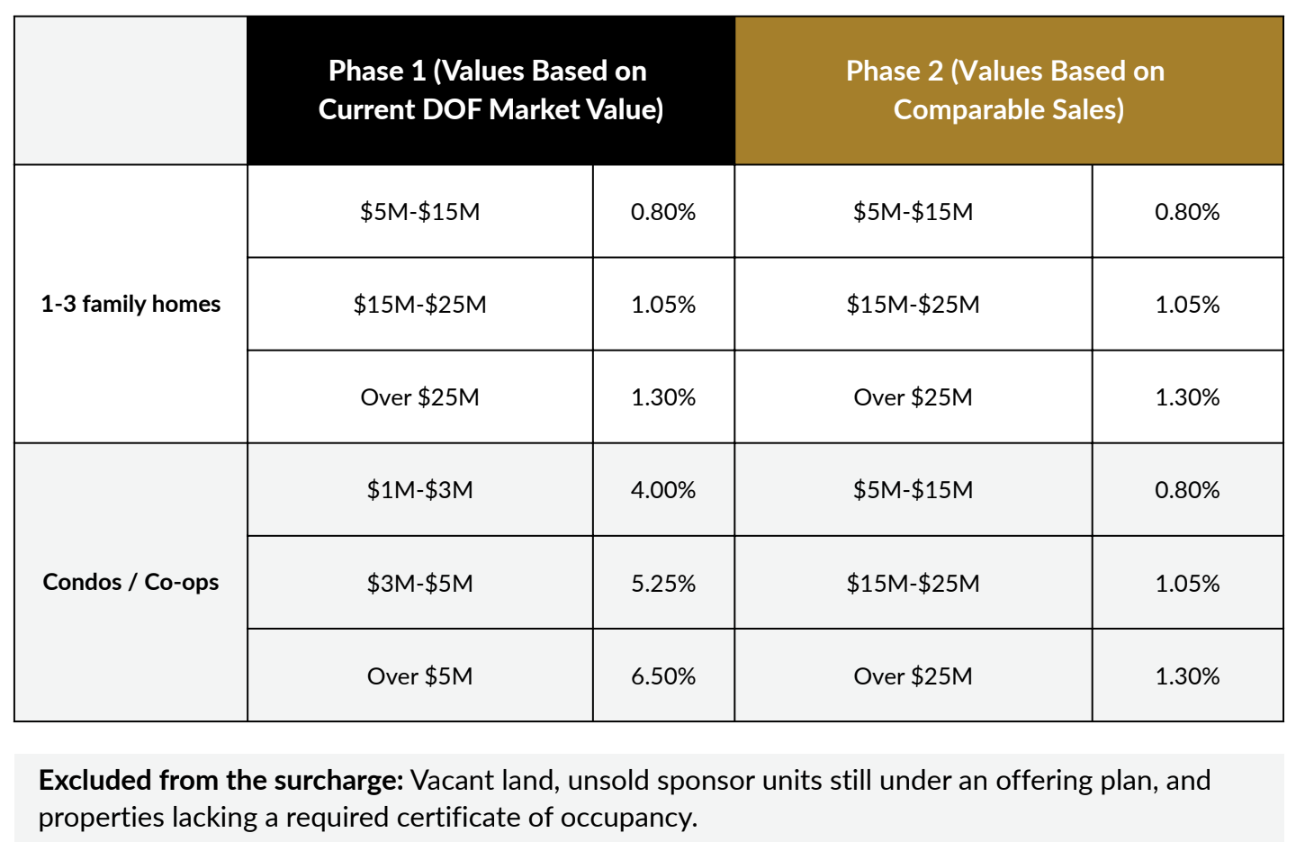
First of all, the table below summarizes the details of this surcharge. But it’s important to keep in mind that these valuations are based on those published by the Department of Finance, and currently those valuations are far lower than actual market values.
An example: I looked up a recent sale of mine with a contract (market) price of $5 million. The valuation by the Department of Finance for this home is $950,000. That’s less than a fifth of its market value.
Under today’s rules, that $5M property would not be subject to the surcharge. Similar examples are common.
Observations worth noting:
1. This isn’t simply a “second home tax”
The surcharge applies to residential properties that do not qualify as a primary residence, but qualification isn’t always straightforward.
Primary residence status isn’t determined simply because an owner says they live there. Owners may need to demonstrate eligibility through documentation if challenged by the Department of Finance, and the City now has authority to verify information, including certain state tax records.
For luxury buyers with multiple residences, international clients, or complex ownership structures, I highly recommend a call with an informed attorney. I’m happy to provide resources as well.
2. The biggest surprise may be how condominiums and co-ops are valued
One of the most overlooked aspects of the legislation is that the valuation methodology changes in 2028.
From now through June 2028, the surcharge is calculated using existing Department of Finance home values.
However, beginning July 2028, the City will move to a comparable sales methodology that is expected to produce values much closer to actual market prices. At the same time though, surcharge rates drop substantially, from as high as 6.5% to between 0.8% and 1.3%.
Many people see the lower rates and assume the tax becomes smaller.
Not necessarily.
Because the taxable value itself could increase dramatically, some owners may ultimately owe similar or even larger amounts despite the lower percentage.
3. Co-op boards suddenly have a much larger role
This legislation doesn’t only affect owners.
For cooperative buildings, boards are responsible for collecting the surcharge from affected shareholders after paying the City, while also determining which apartments qualify as primary residences.
That introduces administrative responsibilities that most co-op boards have never had before, along with potential legal and financial exposure if disputes arise.
I ran into a friend who sits on a Park Avenue Coop board. She expressed how her board as well as many others are feeling frustration at this new law and trying to
4. There are still major unanswered questions
One thing surprised me about this new law.
Many practical issues have not yet been resolved.
Among them:
- How will mixed occupancy two and three family homes be treated?
- How will mid year sales affect liability?
- How will unusual co-op share structures be handled?
- What documentation will ultimately satisfy primary residence requirements?
Much of this is expected to be clarified through future Department of Finance rule-making rather than the legislation itself.
As with most tax legislation, the details matter. Before making assumptions about how this law affects you, it’s worth speaking with an experienced real estate attorney and tax and real estate advisors.
An Afternoon at the Whitney
I spent an afternoon at the Whitney last week with friends, including a private tour led by a dear friend who serves as a docent. The Biennial is one of the museum’s most anticipated exhibitions, and this year’s edition lived up to the anticipation. Here are two works that particularly resonated with me.
This is the 82nd edition of the Whitney Biennial. Here’s an excerpt from the Whitney’s description of this year’s Biennial:
“…like those before it, it offers a space for contemplating the shifting currents of art in the United States, asking not only what is being made but also what it means to name something “American” at all. Attentive to the feelings that saturate contemporary life and bind people together, this Biennial is less a definitive answer than an invitation to tune in to the moods offered by an intergenerational and international group of fifty-six artists, duos, and collectives who sustain this ongoing conversation.
Alongside artists from across the country, the exhibition features works by artists from places marked by the broad reach of US power, ranging from Afghanistan to Vietnam. Using a range of media and artistic strategies, they explore interspecies kinships, familial relations, geopolitical entanglements, technological affinities, infrastructural networks, precarious ecologies, and shared mythologies.
As an ensemble, their works suggest togetherness through difference, avoiding clear ideological declarations in favor of the unusual alliances, improvised provocations, and irreverent associations that are required to thrive in the present moment.”
And now a couple of my favorite works:
Sarah M. Rodriguez
Born 1984 in Honolulu, HI; lives in Ojo Caliente, NM
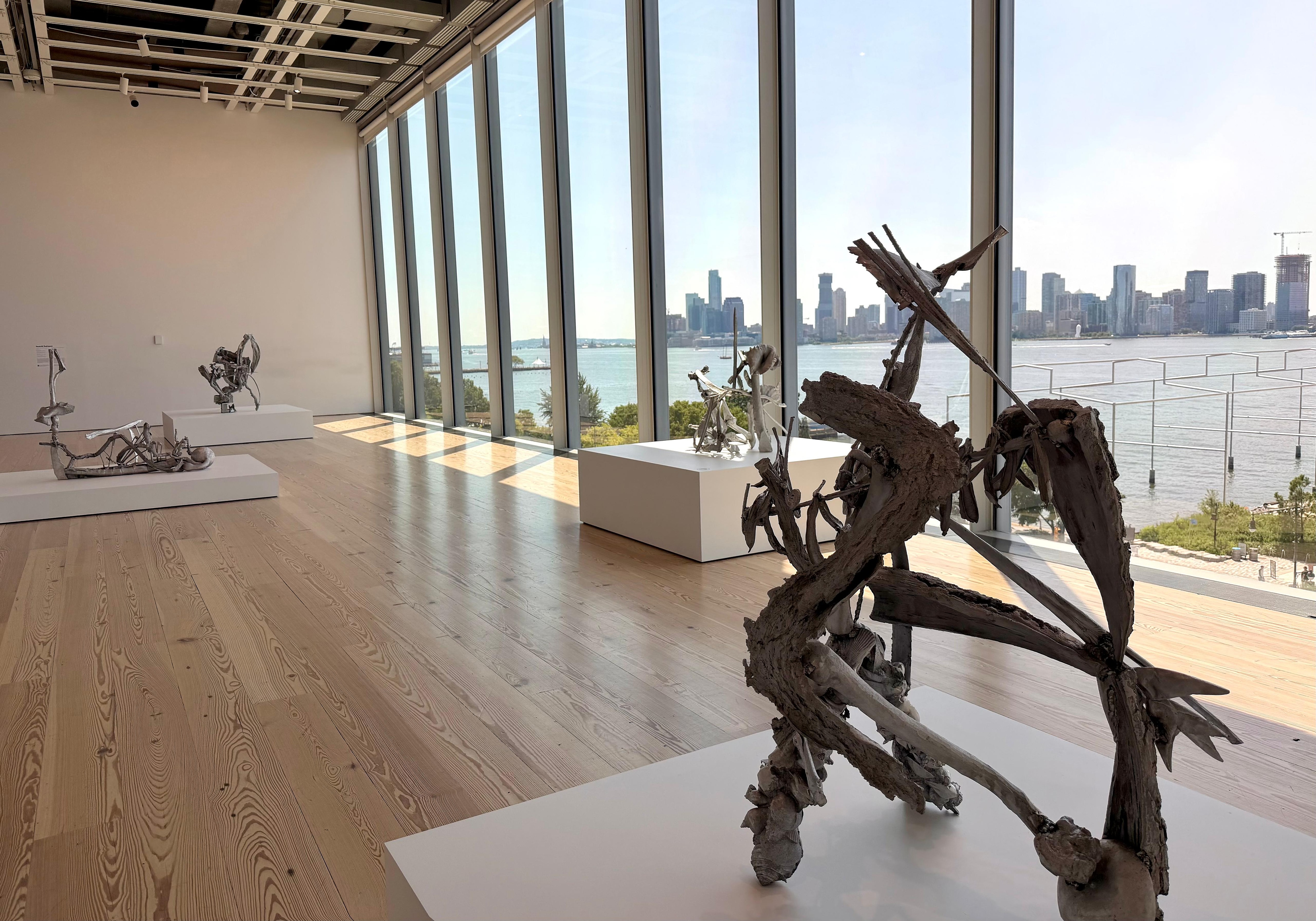
In this photo:
- Scent-Vane, 2025 Cast, carved, and welded aluminum
- Cover/Cross, 2025 Cast, carved, and welded aluminum
- Disperse, 2025 Cast, carved, and welded aluminum
- Coil, Gather, Leap, 2025 Cast, carved, and welded aluminum
Sarah M. Rodriguez collects branches, pods, and other natural objects, casts them in aluminum using sand molds, and welds the casts into sculptural compositions. The resulting works feel both ancient and contemporary, blurring the line between the natural and man-made.
Carmen de Monteflores
Born 1933 in San Juan, Puerto Rico; lives in Berkeley, CA
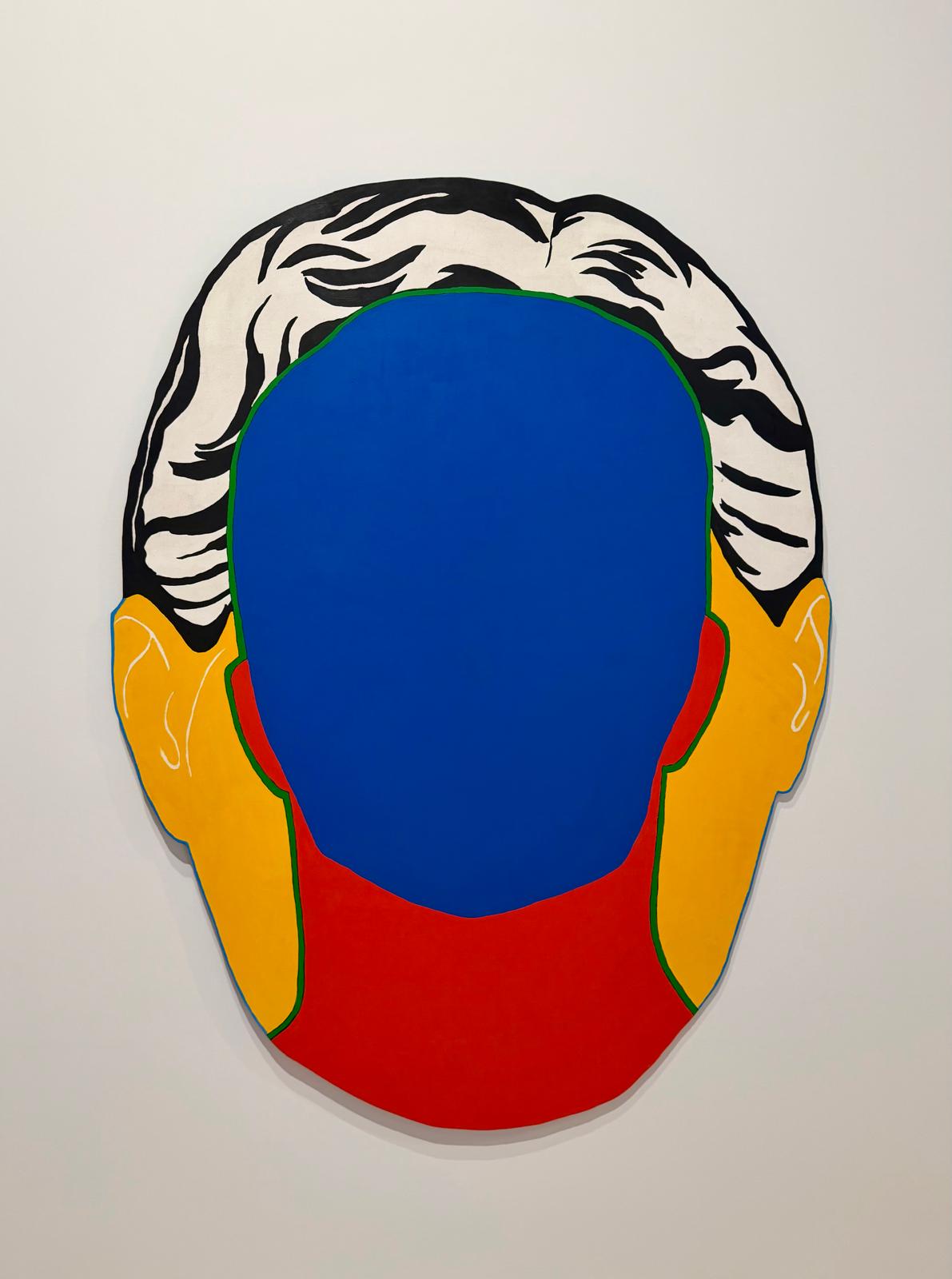
From left:
- Via Crucis IV, 1967 Acrylic on canvas
Via Crucis IV reflects Carmen de Monteflores’ bold graphic style, reducing the human figure to simple forms and vivid color. The image invites a second look: what first appears to be the back of a man’s head can also be seen as the profile of a woman’s face, often interpreted as Christ and the Virgin Mary. The result is at once visually dramatic, elegant, and deeply moving.
Whitney’s description:
Carmen de Monteflores’s shaped canvases of the late 1960s combine fields of color with a bold, graphic style. Her process always began with observation, drawings of the landscape, her family, or other figures. This practice gave the lines and edges in her work an organic quality that distanced the work from the more mechanical approach of Pop art from around the same time. Frustrated by the lack of opportunities for women in the art world, de Monteflores stopped painting in 1969, received a doctorate in psychology, and wrote five novels.