
The Agent Behind That Zillow Listing May Not Be Who You Think
Brooklyn's third-quarter market showed a continued contraction in inventory and sales activity. According to the Compass Q3 Market Report, inventory fell 12.2%
Contents
Brooklyn Q3: Tightening Supply, Diverging Prices
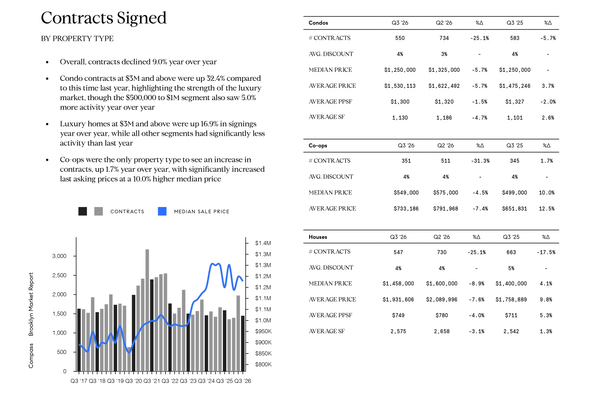
Brooklyn’s third-quarter market showed a continued contraction in inventory and sales activity. According to the Compass Q3 Market Report, inventory fell 12.2% year over year, while new listings declined 16.8% and contracts signed dropped 9%.
Houses experienced the sharpest decline in activity, with contracts down 17.5% and new listings falling 28.4%.
But the borough-wide figures tell only part of the story.
Northwest Brooklyn, which includes some of the borough’s most desirable brownstone neighborhoods, accounted for 755 recorded sales during the quarter, approximately 28% of all Brooklyn transactions.
Its townhouse market was particularly interesting. Sales increased 5% year over year, while the average price per square foot rose an impressive 21.8% to $1,469. The median townhouse price, however, declined slightly to $3.32 million.
Condominium median prices slipped 1.9% to $1.57 million, while co-op median prices declined 6.3% to approximately $896,000.
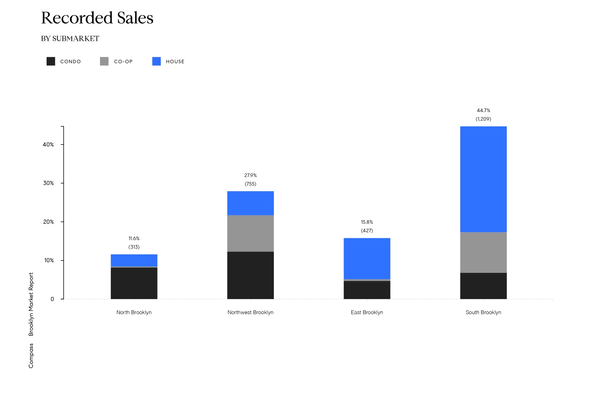
North Brooklyn presented a different picture. Condo sales fell 15.6%, yet median prices increased 9.9% to $1.45 million. House transactions remained nearly unchanged, while median house prices declined 4.5% to $1.86 million.
These contrasting trends are a reminder that Brooklyn’s market cannot be characterized by a single headline. Inventory remains constrained, transaction volume has softened, and pricing varies significantly by neighborhood and property type.
Perhaps the most interesting figure is Northwest Brooklyn’s 21.8% increase in townhouse pricing per square foot. While changes in the mix and size of homes sold can influence that measure, it suggests continued demand for desirable townhouse properties in the borough’s established residential neighborhoods.
When the Listing Isn’t on StreetEasy or Zillow
Who should decide how a home is marketed?

An article in The Wall Street Journal this week, “The Fierce Battle to Control How Americans Buy and Sell Their Homes,” is among several recent reports examining a recent debate in residential real estate: private listings.
At the center of the debate is Compass and its approach to marketing properties before they appear on public aggregator sites such as StreetEasy and Zillow.
Zillow and StreetEasy, which Zillow owns, have built lucrative businesses around real estate listings. The properties attract prospective buyers, whose inquiries can then be directed to agents participating in the platforms’ paid advertising and referral programs.
What many buyers don’t realize is that the agent receiving their inquiry is not necessarily the listing agent. That agent may have had no involvement in marketing the property and little firsthand knowledge of it.
I find this practice troubling. A buyer interested in a particular home may reasonably assume they’re being connected with someone who actually knows the property, rather than an agent seeking a new client. In my view, the distinction is not always sufficiently transparent.
And this is an important part of the increasingly contentious debate over who controls how homes are marketed—and who profits from that exposure.
And therein lies much of the controversy surrounding private listings.
As a broker, I believe the fundamental question is: Who should decide how a property is marketed—the seller or the platforms on which listings appear?
The Compass Approach
Compass has challenged the notion that every property must immediately appear on public listing portals. Instead, Compass offers sellers the option of introducing their property privately, first within its brokerage network and then, if desired, through a Coming Soon listing on Compass.com, before launching publicly on StreetEasy, Zillow, and other aggregator platforms.
The idea is to give sellers greater control over how and when their property reaches the broader market.
Why Would a Seller Choose to Start Privately?
- Privacy. Some homeowners prefer not to publicize their property, photographs, or asking price, particularly at the luxury end of the market.
- Testing pricing and presentation. Early buyer feedback can be invaluable, especially for unusual properties where comparable sales offer limited guidance. It allows sellers to make adjustments before launching publicly.
- Protecting public marketing history. Once a listing enters the public marketplace, days on market and price reductions can become part of its visible history. A private introduction may allow sellers to refine their strategy before that public history begins, subject to applicable disclosure requirements.
The Case for Public Exposure
There is, of course, a legitimate argument for going directly to the public market.
Broad exposure reaches more potential buyers and can generate additional showings and competing offers. Limiting visibility may mean missing qualified buyers who would otherwise have been interested.
For many properties, I would recommend a full public launch from the outset.
But for others, particularly those where discretion is important or pricing requires careful calibration, a private introduction may offer meaningful advantages.
My view: After nearly two decades selling New York real estate, I firmly believe sellers should have the right to decide how their properties are marketed, with a clear understanding of the advantages and trade-offs.
The goal is to achieve the best possible outcome for the seller, not to maximize traffic or lead generation for a listing portal.
An $80 Million Carriage House
From horse stables to one of Manhattan’s most expensive homes
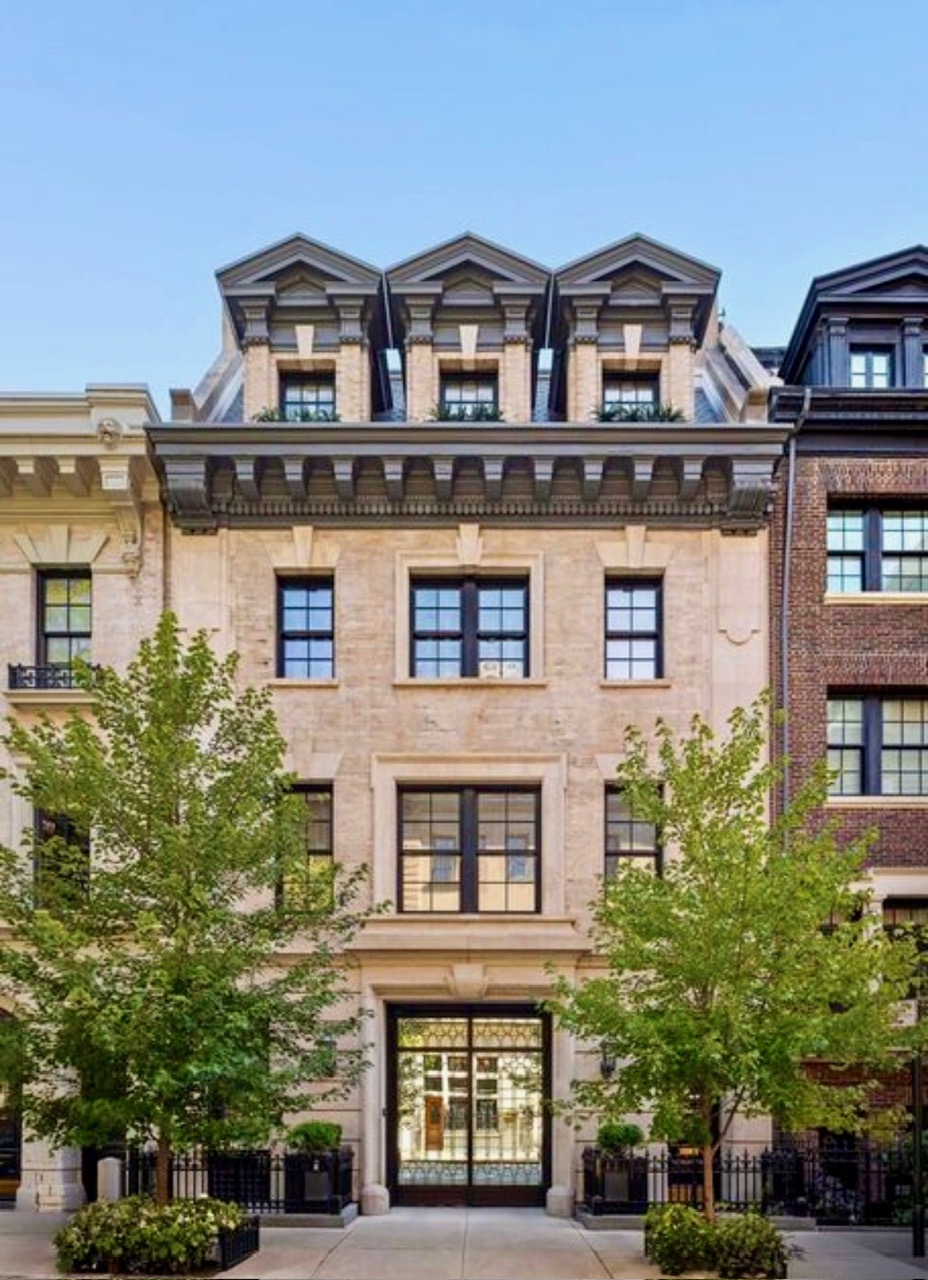
Former Morgan Stanley chief John Mack and his wife, Christy, have listed their converted Upper East Side carriage house at 165 East 70th Street for $80 million.
A former carriage house at 165 East 70th Street has just come to market for $80 million, making it the most expensive townhouse currently listed for sale in New York City. If it achieves its asking price, it would surpass Manhattan’s townhouse sales record of $77.1 million, set in 2019 at 14 East 67th Street.
Built in 1902 for banker Henri Wertheim and designed by architect C.P.H. Gilbert, the limestone Neo-Italian Renaissance building originally housed horses and carriages. It later became a private garage and chauffeur’s quarters for Singer heir Stephen C. Clark and, subsequently, for Paul and Bunny Mellon.
In 2009, former Morgan Stanley CEO John Mack and his wife, Christy, purchased the property for $13.5 million. Over the following years, they undertook an extensive transformation, converting the former garage into an approximately 16,000-square-foot, 20-room private residence while preserving its landmarked facade.
The scale is remarkable: six bedrooms, six wood-burning fireplaces, three landscaped terraces, a 13-seat screening room, a private wellness suite, and a temperature-controlled wine cellar accommodating precisely 6,319 bottles. There are two elevators and a private garage that can also be used for entertaining.
One of my favorite details is the reuse of the original chestnut horse ramps, now incorporated into the walls and floors of the gym. A wonderful connection to the building’s original purpose.
At approximately $5,000 per square foot, the asking price places the property in the highest reaches of Manhattan’s townhouse market. Whether a buyer will pay $80 million remains to be seen. But there are very few Manhattan homes that offer this combination of architectural history, extraordinary scale, and a complete modern transformation.
Roy Lichtenstein, Beyond the Ben-Day Dots
Roy Lichtenstein: Like New | Whitney Museum of American Art

“Roy Lichtenstein’s breakthrough Pop work stunned both the art world and the country when it was first shown in the early 1960s.” — Whitney Museum of American Art
The Whitney’s first major New York retrospective of Roy Lichtenstein in 33 years brings together approximately 130 works spanning six decades. Among the highlights are the reunion of all eight paintings from his groundbreaking 1962 exhibition at Leo Castelli Gallery and a recreation of his nearly 96-foot-long Greene Street Mural, originally created in 1983 and subsequently destroyed.
Best known for his comic-inspired paintings and signature Ben-Day dots, Lichtenstein was fascinated by how images are borrowed, copied, enlarged, and transformed.
As the Whitney explains, his work went far beyond Pop Art, exploring questions of perception, authorship, and the relationship between original images and their reproductions. Although his paintings appeared mechanically produced, they were meticulously handmade.
What I find particularly interesting is the exhibition’s relevance today. As the Whitney observes, we live in an era when images are endlessly cropped, filtered, reposted, and recirculated. Add artificial intelligence to the equation, and Lichtenstein’s decades-long exploration of originality and reproduction feels especially timely.
On view through May 10, 2027.