
The Higher the Price, the Stronger the Year?
For many New Yorkers, Fairfield County has long been less a departure from the city than an extension of it. Greenwich, Darien, New Canaan, Westport and
Contents
Wishing you and your families a wonderful Labor Day weekend.
Just Beyond New York
Fairfield County, From Greenwich to Westport
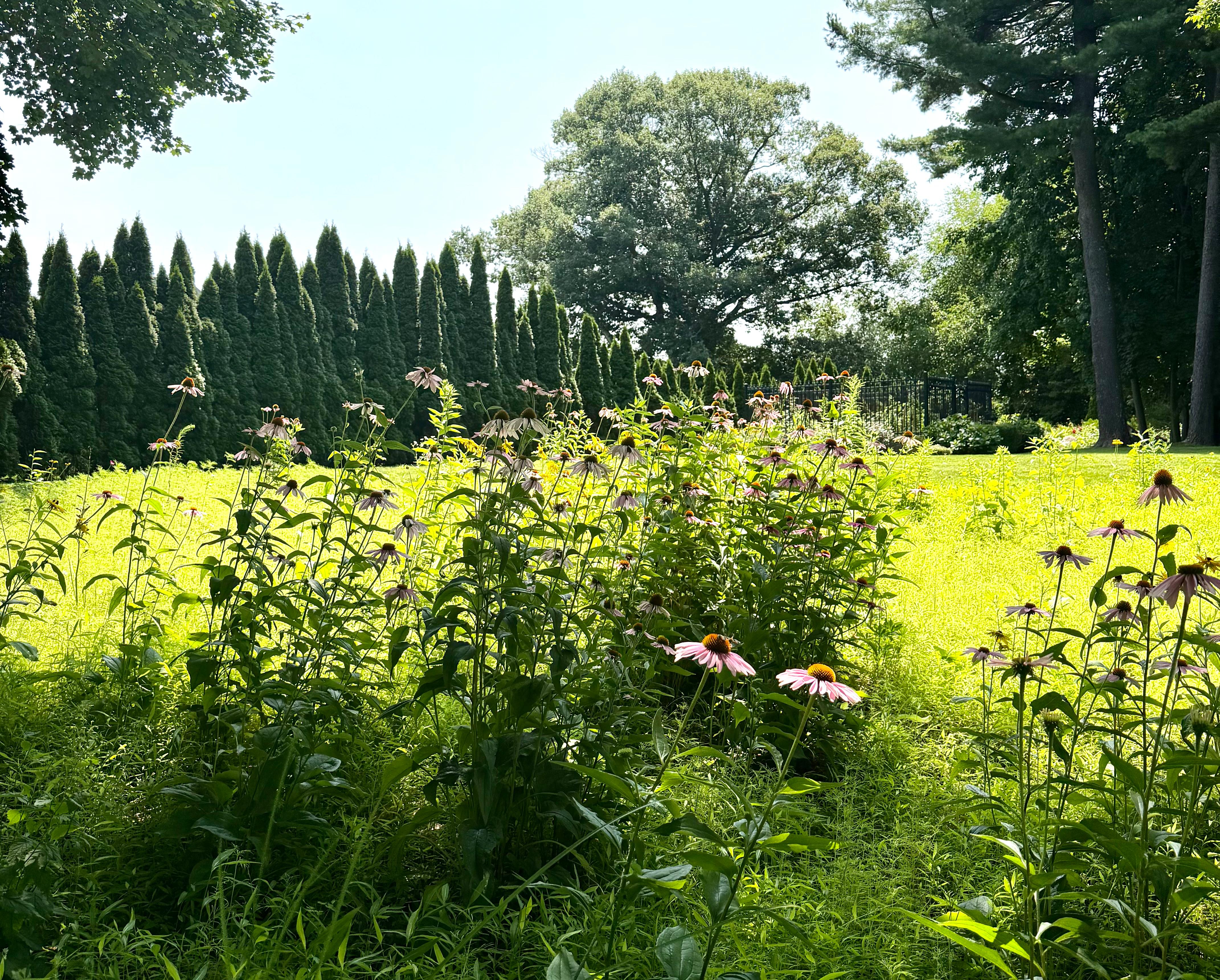
For many New Yorkers, Fairfield County has long been less a departure from the city than an extension of it.
Greenwich, Darien, New Canaan, Westport and Stamford each offer something quite different, but they share a proximity to Manhattan that has made this stretch of Connecticut especially compelling: more space, strong communities, access to the coast and countryside, and in many cases a relatively easy connection back to New York.
The market remains competitive. Across Fairfield County, the median sale price over the three months ending in July was approximately $792,000, up 9.3% year over year, while more than 62% of homes sold above asking. Greenwich was even stronger, with a median sale price of approximately $2.8 million, up 10.9%, while Darien and New Canaan also posted substantial year-over-year gains.
But what interests me about Fairfield County is not simply the housing market. It is the variety.
Greenwich offers the closest thing to an established luxury market on Manhattan’s doorstep. Darien and Westport combine coastal living with lively town centers. New Canaan has long been associated with architecture and design, while Stamford offers a more urban alternative. (Scroll down for a curated selection of properties currently on the market in Fairfield County.)
And then there are the places that give the area its character. Read below about one of the most important mid-century modern architectural landmarks of the 20th century.
The Glass House
The Modernist Legacy of New Canaan
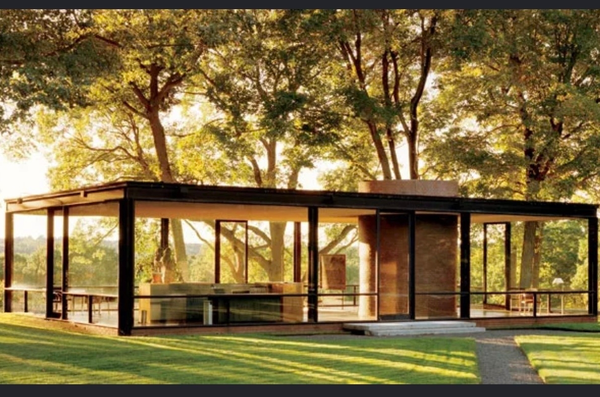
Completed in 1949, The Glass House in New Canaan is one of the defining works of American modernism.
New Canaan itself became an important center of modernist architecture in the years after World War II.
A group of architects later known as the Harvard Five — Philip Johnson, Marcel Breuer, Eliot Noyes, John Johansen and Landis Gores — settled there and began designing houses for themselves and their clients. By the end of 1952, more than 30 modern houses had been built in town; by the end of the 1970s, there were more than 100.
Johnson purchased his first five acres in New Canaan in 1946 and completed The Glass House three years later. Designed as his own residence, it is radically simple: a glass pavilion set within the landscape, with almost no visual separation between inside and out.
That relationship between architecture and nature is one of the reasons I have always been drawn to mid-century modern design.
Years ago, when we were looking for a place outside New York City, we found our own mid-century modern home in New Canaan. It has become my refuge. There is something about living with walls of glass, surrounded by trees, where the seasons become part of the interior and the distinction between indoors and outdoors almost disappears.
Perhaps that is why The Glass House resonates so strongly with me.
And the house itself is only part of what Johnson created. Over several decades, the property grew into a 49-acre architectural landscape of buildings, galleries, art and gardens, all conceived in dialogue with one another and with the land.
For anyone interested in architecture and design, The Glass House is well worth a visit. But it also offers a glimpse into something larger: the remarkable modernist legacy that still distinguishes New Canaan today.
The BAHAR Manhattan Market Pulse
August was soft. The year-to-date story shows the higher end is proving more resilient.
August is typically a quieter month in Manhattan real estate, and this year the broader market did slow compared with last August. But the picture varied considerably depending on price point.
Compared with August 2025, contracts signed changed as follows:
- Overall Manhattan: 841 to 740, down 12.0%
- $4M+ market: 86 to 89, up 3.5%
- $10M+ market: 18 to 13, down 27.8%
The divergence is notable. While the overall market softened and the $10M+ segment saw a meaningful pullback, the $4M+ market actually posted slightly more contracts than it did a year ago.
The Demand Ratio
Over time, I’ve found that looking at inventory or contracts signed in isolation does not always tell the full story. So I decided to use a simple measure that better captures the relationship between the two.
I’m calling it The Demand Ratio: the number of contracts signed in a given month as a percentage of active inventory. It is a way of measuring how much of the available market is actually being absorbed by buyers.
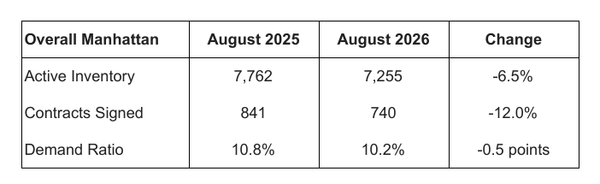
As the table below shows, active Manhattan inventory in August was 6.5% lower than a year ago. Contracts signed, meanwhile, declined 12.0%.
That moved The Demand Ratio from 10.8% in August 2025 to 10.2% in August 2026.
The takeaway: demand softened, but the overall balance between supply and buyer activity remained relatively close to last year.
The Year To Date Picture Is More Nuanced
One month does not define a market.
Through August, overall Manhattan contract activity remains below 2025 levels, but the higher end has shown considerably more resilience.
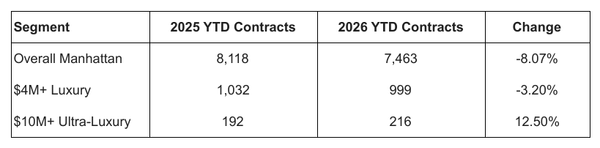
Overall Manhattan recorded 8.1% fewer contracts through August than during the same period last year.
The $4M+ market has been substantially more resilient, down just 3.2% year to date.
And the $10M+ market tells a different story altogether. So far this year, contracts signed are 12.5% higher than during the same period in 2025.
That divergence is important.
The higher the price point, the less closely the market is tracking the broader Manhattan slowdown.
A softer August and a stronger ultra-luxury year can both be true.
Luxury Is Not Behaving as One Market
The $4M+ market was actually stronger this August than last August and remains only modestly below 2025 year to date.
The $10M+ market, by contrast, had a much weaker August but remains meaningfully ahead for the year.
That distinction matters when evaluating pricing power, negotiating leverage and the depth of the buyer pool.
“Luxury” is not a single market.
What It Means
For sellers: Lower inventory remains supportive, but slower absorption raises the cost of overpricing. In this market, pricing precision matters.
For buyers: Softer absorption can create greater negotiating room, particularly where inventory has been lingering or buyer competition is limited.
What we are watching: September will bring the first important test of the fall market: whether the return of new inventory is met by a meaningful seasonal rebound in contract activity.
The BAHAR Manhattan Market Pulse draws upon The BAHAR Team’s ongoing tracking of inventory, contract activity and market liquidity across overall Manhattan, the $4M+ luxury market and the $10M+ ultra-luxury market. For clients considering a purchase or sale, we apply the same analysis at the neighborhood, building and individual property level.