
September 11, 25 Years Later — A Reinvented Downtown
This week marks 25 years since September 11, 2001. The anniversary inevitably brings us back to the lives lost and to a day that changed New York—and the
Contents
This week marks 25 years since September 11, 2001.
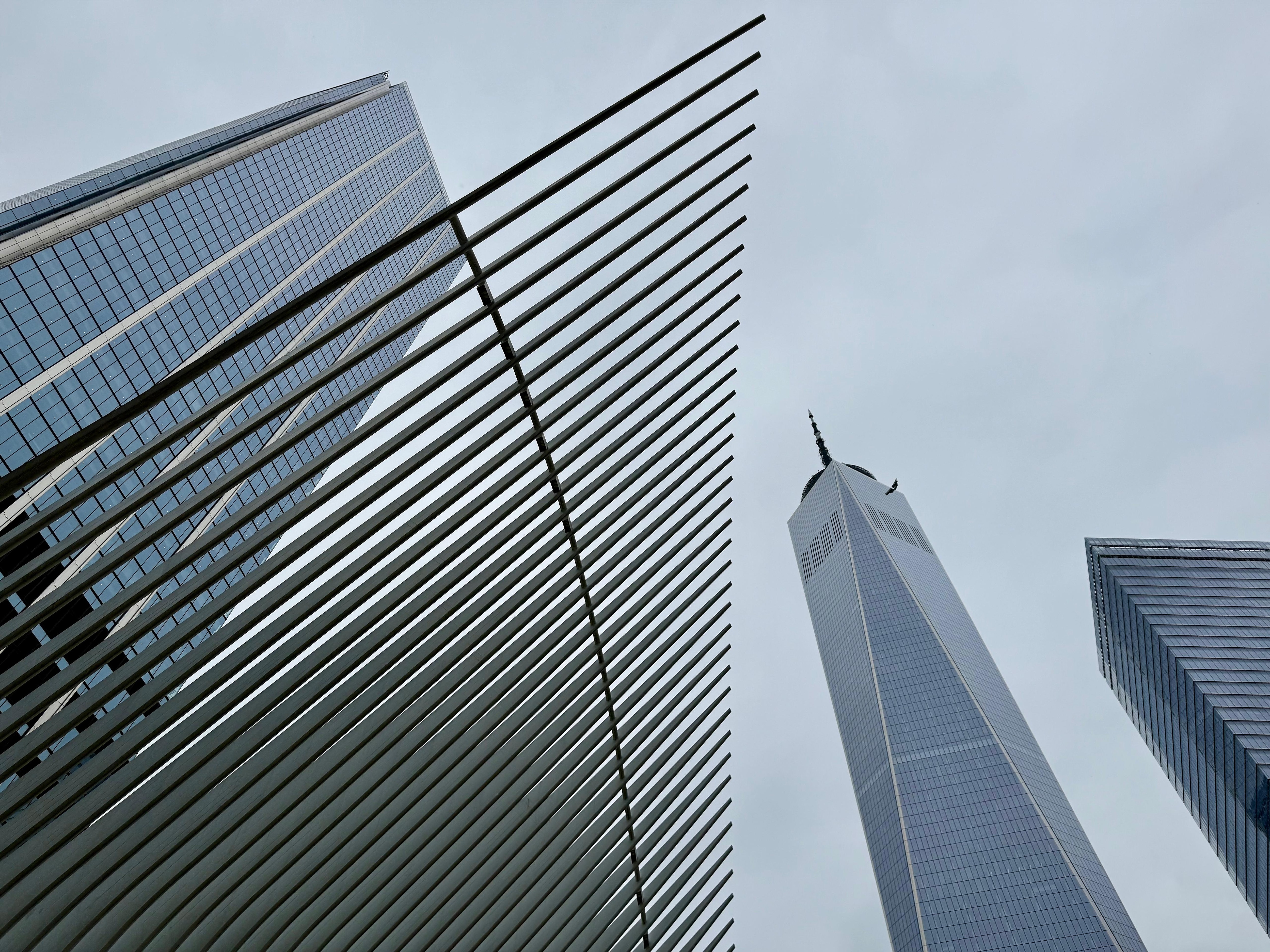
The anniversary inevitably brings us back to the lives lost and to a day that changed New York—and the world—forever. But it also offers a moment to consider what followed: the long, complicated and ultimately remarkable reinvention of Lower Manhattan.
Few could have imagined then that downtown would become one of the city’s fastest-growing residential neighborhoods. Its recovery offers a larger lesson about New York: the city has not simply rebuilt what was lost. Few could have imagined then that downtown would become one of the city’s fastest-growing residential neighborhoods. Its recovery offers a larger lesson about New York: the city did not simply rebuild what was lost.
Downtown Manhattan evolved into a place where residential life, art and culture now exist alongside one of the world’s great financial centers.
This week, I also look at mortgage rates nearing 7%, the Perelman Performing Arts Center, and an extraordinary Upper West Side home that offers the scale of a townhouse high above the street.
This Week
- Lower Manhattan at 25 — How downtown became a neighborhood as well as a business district.
- Rates Near 7% — What higher-for-longer borrowing costs mean for buyers and sellers.
- A Cultural Anchor Downtown — The remarkable building bringing performance and public life to the World Trade Center.
- A Townhouse Above the Street — Introducing 428 Columbus Avenue.
Lower Manhattan at 25
In the months after September 11, 2001, many questioned whether Lower Manhattan could recover. Some predicted that businesses, residents and visitors would never fully return.
What followed was not simply rebuilding. It was reinvention.
Over the past 25 years, Lower Manhattan has evolved from a district largely defined by the working day into a residential, cultural and commercial neighborhood with life around the clock.
According to The Wall Street Journal, the downtown population has roughly tripled over the past quarter-century, while more than 230,000 people now work there. This is nearly as many as before the attacks.
Approximately $20 billion in public and private investment created about 10 million square feet of office space, nearly half a million square feet of retail, new transportation infrastructure, the 9/11 Memorial and Museum, and the Perelman Performing Arts Center.
But perhaps the most important shift took place in buildings that were already there.
Flexible zoning and financial incentives allowed aging office properties to be converted into residences. Nearly 25,000 housing units were added, bringing life to streets that had once emptied after the markets closed. New parks, schools, restaurants, hotels and cultural institutions followed.
The result is one of the most consequential urban transformations in modern New York: not the restoration of the old Financial District, but the creation of a far more complete neighborhood.
The final major tower at the World Trade Center site is now underway. American Express broke ground this summer on its new 55-story headquarters at 2 World Trade Center, nearly completing the physical rebuilding of the campus.
Twenty-five years later, Lower Manhattan is almost unrecognizable from what many feared it would become. Its transformation is also a reminder of one of New York’s enduring strengths: its ability to adapt, reinvent itself and emerge more livable, more varied and more resilient.
Rates Near 7%
For much of this year, buyers have been waiting for mortgage rates to move meaningfully lower.
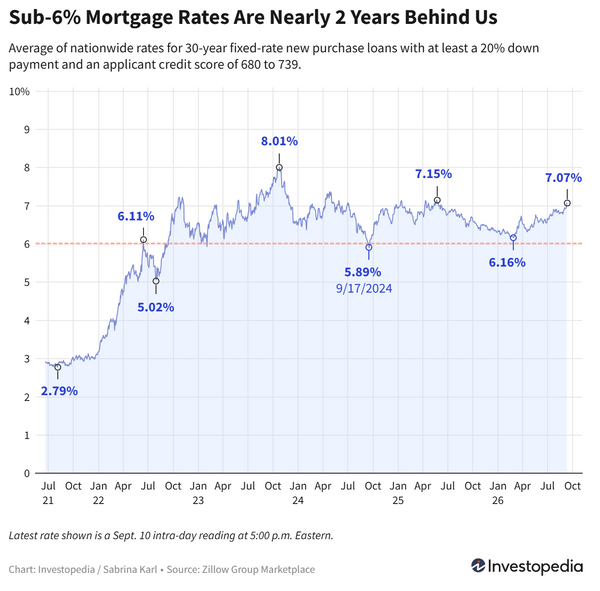
Instead, the average rate for a 30-year fixed mortgage has climbed to approximately 6.99%, its highest level in 15 months and more than 80 basis points above its February low.
The change reflects a broader reassessment of where interest rates may be headed. According to Reuters, most economists surveyed expect the Federal Reserve to leave rates unchanged through the remainder of 2026, while a growing number now believe at least another increase is possible. Persistent inflation, stronger economic data and higher energy prices have made the path forward less predictable.
For Manhattan real estate, the consequences are uneven.
The luxury market remains comparatively insulated because a much higher proportion of purchases are made with cash.
At other price points, however, even a modest rate increase can materially affect monthly payments and purchasing power.
Buyers who have spent the year waiting for substantially lower rates may now need to reconsider whether waiting is still the best strategy.
Sellers should also pay attention. Higher rates do not eliminate demand, but they make buyers more exacting. Properties that are well priced, well presented and difficult to replicate continue to attract attention. Those that enter the market ahead of where buyers perceive value may sit, regardless of broader market strength.
The more useful question may no longer be, “When will rates return to where they were?” It may be, “How do we make the right decision in the market we actually have?”
A Cultural Anchor Downtown
For years, the rebuilding of the World Trade Center was measured largely through office towers, transportation infrastructure and the solemn spaces of the 9/11 Memorial and Museum.
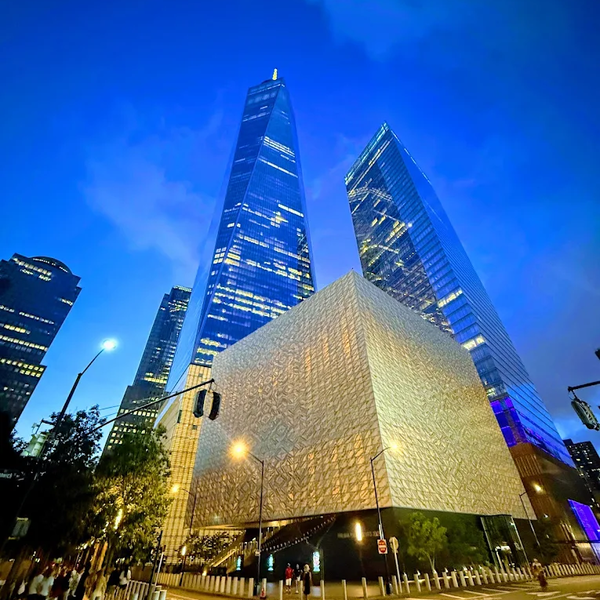
The arrival of the Perelman Performing Arts Center, known as PAC NYC, added something different: a place devoted to performance, gathering and public life.
Designed by the architecture firm REX, the building sits beside One World Trade Center like a luminous marble cube. During the day, its Portuguese-marble façade appears solid and restrained. At night, it glows from within, becoming a striking presence beside One World Trade Center.
The apparent simplicity of the exterior conceals an extraordinarily flexible interior. Three performance spaces can be rearranged into more than 60 configurations, accommodating everything from intimate productions to audiences approaching 1,000 people. The lobby and restaurant were conceived as publicly accessible gathering places, even for those who are not attending a performance.
The center is named for Ronald Perelman, whose $75 million gift helped move the long-delayed project forward. Michael Bloomberg, chairman of its board, contributed $130 million and played a major role in bringing the center to completion.
Its significance extends beyond architecture. Lower Manhattan could not become a complete neighborhood through residences, offices and transportation alone. It also needed places where people could meet, experience art and remain after the working day ended.
PAC NYC represents another dimension of downtown’s reinvention: a site once defined principally by loss becoming a place where new work, new ideas and new memories can be created.
Townhouse Scale. Penthouse Views
Some New York homes resist easy categorization.
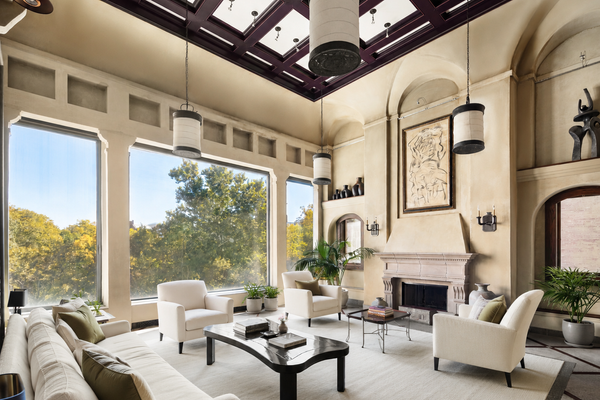
The Penthouse at 428 Columbus Avenue combines the privacy and expansive proportions of a townhouse with the light, views and outdoor space of a penthouse.
The building has its own distinctive Upper West Side history.
Built in 1900, 428 Columbus Avenue arrived at a pivotal moment in the neighborhood’s development. The extension of the Ninth Avenue Elevated train, known as the El, along Columbus Avenue in 1879 had opened the neighborhood to development, transforming what had been a relatively undeveloped part of Manhattan into a thriving residential and commercial district within little more than two decades.
Designed by architect Charles J. Ferry for Julius Jungman, a physician and druggist who operated his business from the property, the building’s unusually large windows were designed to catch the attention of passengers passing almost at eye level. The building later became home to an antiques and curiosities business, turning those expansive windows into an elevated storefront for riders on the El.
More than a century later, those same proportions help give the residence its extraordinary light and views.
Today, the building has been transformed for contemporary living while retaining the scale and architectural character that make it so distinctive.
Occupying multiple levels above Columbus Avenue, the approximately 5,285-square-foot residence overlooks the grounds of the American Museum of Natural History and extends toward Central Park.
At its center is the dramatic double-height Great Room, framed by immense picture windows and anchored by a distinctive fireplace. To the east, the views extend over the Museum grounds and the distinguished buildings of West 81st Street, with the Beresford rising prominently beyond. To the south is the Midtown skyline; to the west, the rooftops and architecture of the Upper West Side.
The five-bedroom residence includes a primary suite occupying an entire floor, four additional ensuite bedrooms and a newly completed guest or entertainment level with its own bath, kitchenette and east- and west-facing terraces.
The principal top-floor terrace looks east across the Museum grounds toward Central Park. Additional terraces create multiple outdoor spaces at different levels of the home.
It is, quite simply, a private townhouse perched above the street.
428 Columbus Avenue, Penthouse 5 Bedrooms | 5 Bathrooms | 2 Powder Rooms Approximately 5,285 Interior Square Feet Multiple Private Terraces Price Upon Request