
What Makes Wealth Stay — Or Leave?
A trip from San Francisco to Napa and Sonoma, then on to Britain's tax debate, on why some places turn talent and capital into lasting prosperity.
Contents
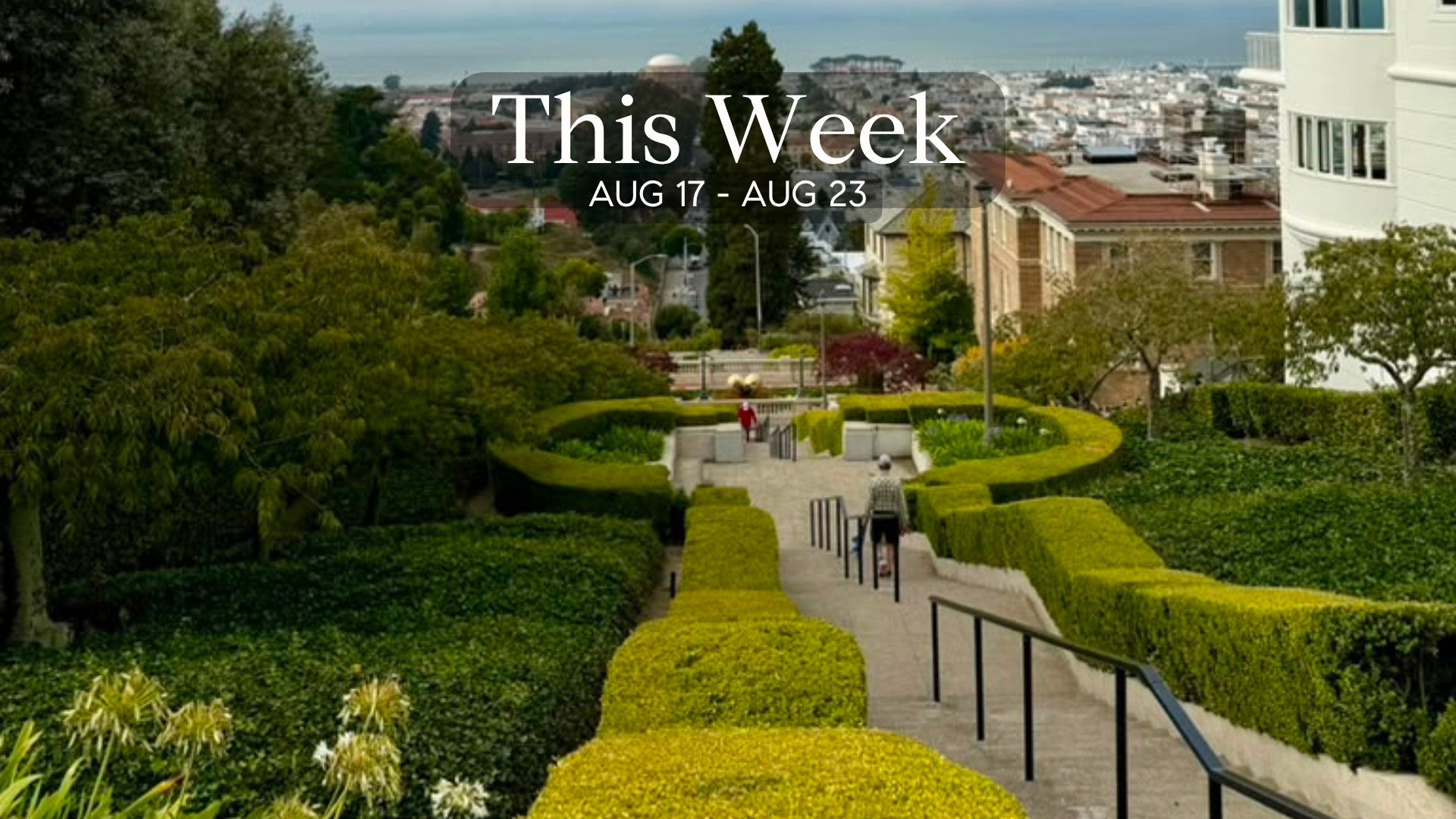
San Francisco: The view from the Lyon Street Steps, where Presidio Heights meets the Pacific Heights, looking north toward the Palace of Fine Arts and the Bay.
Why do some places succeed in attracting talent, investment and people, and then turn those advantages into lasting prosperity?
And why do others make choices that ultimately work against their own desirability?
Case in point: San Francisco.
I spent part of last week in California, moving from San Francisco to Napa and Sonoma.
San Francisco, after several very difficult years shaped in part by poor policy choices and ineffective leadership, is suddenly at the center of another extraordinary cycle of wealth creation.
Less than an hour away, Napa and Sonoma offer something entirely different: open land, agriculture, remarkable natural beauty and a quality of life that continues to draw people.
Travel always provides fresh perspective.
San Francisco’s remarkable turnaround got me thinking more broadly about the choices places make, and took me this week from California to Britain, and inevitably back to New York.
Very different places, but each with an interesting lesson.
California, Revisited
How AI, Capital and Talent Are Reshaping the City

Pacific Heights’ ornate Victorian-era homes, with their bay windows, elaborate trim and richly detailed façades.
I wrote recently about the remarkable strength of San Francisco’s housing market. Being there made the story feel considerably bigger than real estate.
Only a few years ago, San Francisco had become the symbol of the post-pandemic urban crisis: empty offices, a struggling downtown, declining population and persistent questions about whether the technology industry still needed the city that had helped create it.
The narrative has changed remarkably quickly.
Artificial intelligence has put the Bay Area back at the center of global technology investment. Since 2020, approximately 80% of U.S. venture-capital investment in AI has gone to the San Francisco Bay Area. Tech and AI companies leased more than 14 million square feet of office space in San Francisco and Silicon Valley in 2025 alone, accounting for more than half of all leasing activity. Institutional investors, largely absent from the office market only a few years ago, are returning as well.
That doesn’t mean San Francisco has solved all of its problems. Housing remains extraordinarily expensive, development is difficult and parts of downtown are still recovering. But it is a reminder of how quickly the fortunes of a city can change when talent, capital and innovation begin reinforcing one another again.
California Wine Country
Vineyards, Architecture and Contemporary Art

Darioush Winery in Napa Valley, where architecture inspired by ancient Persia creates a dramatic setting for wine and exquisite hospitality.
Less than an hour away, the landscape changes completely.
Napa and Sonoma feel almost a universe removed from San Francisco. There is open land, rolling hills lined with vineyards, remarkable food and wine, and an extraordinary connection between agriculture, architecture and the natural landscape.
What struck me most was how closely all of these things are connected to the appeal of the region. The technology economy has created much of the wealth in the Bay Area, but quality of life has also helps determine where people ultimately want to spend it.
A highlight of Napa was Darioush Winery, which draws on Persian culture and the architecture of Persepolis. What stayed with me was the extraordinary attention to detail. The architecture, gardens, interiors, food, wine and hospitality all felt exceptionally considered. Even the idea of hospitality is intentional: Darioush describes its philosophy as rooted in taarof, the Persian tradition of gracious hospitality.
Another highlight of the trip was a private tour of The Donum Estate in Sonoma.

Anselm Kiefer’s Mohn und Gedächtnis (Poppy and Memory) (2017): a life-size warplane set improbably among the vineyards of Sonoma (The Donum Estate).
Donum reminded me somewhat of Château La Coste in Provence, though on a much more intimate scale. The estate is owned by Allan and Mei Warburg, passionate collectors who have transformed Donum into something far beyond a winery: nearly 70 monumental works of contemporary art are placed throughout the 200-acre estate, many commissioned specifically for the setting.
Works by Ai Weiwei, Louise Bourgeois, Yayoi Kusama, Anselm Kiefer, Jaume Plensa, William Kentridge and others appear among the vineyards, olive trees and rolling hills.
What makes it memorable is not simply the caliber of the collection, but the relationship between the art and the land. You encounter the works gradually, as you move through the estate, and the landscape becomes part of the experience.
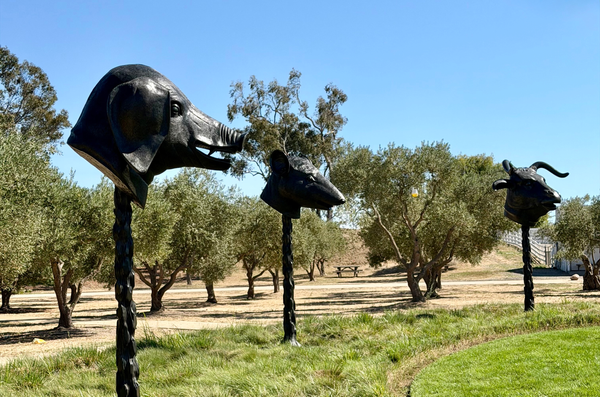
Ai Weiwei’s Circle of Animals/Zodiac Heads, set among the olive trees and vineyards of the Donum Estate, Sonoma.
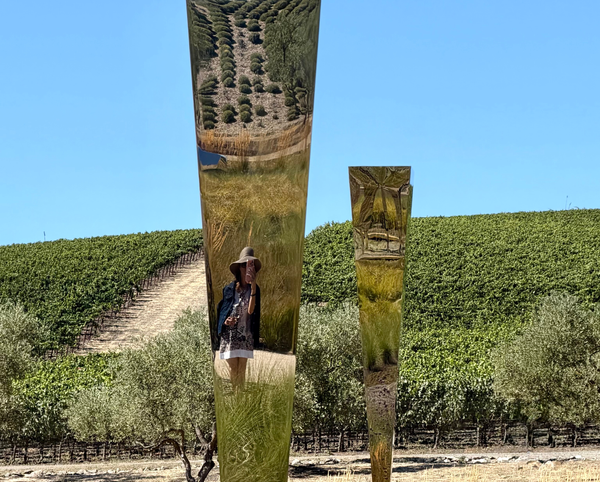
Yang Bao’s Hyperspace, reflecting the vineyards, and here, me as the photographer.
When Tax Policy Changes Behavior
Britain and the Mobility of Wealth
An article I read in the Financial Times recently brought me back to a question that feels particularly relevant to cities like London, New York and San Francisco: at what point does tax policy begin changing behavior?
For generations, London has been one of the world’s great magnets for international wealth. It offers culture, education, financial expertise, extraordinary real estate and a legal system that has historically attracted global capital.
But Britain has recently changed the way it taxes wealth. Beginning in April 2025, the longstanding non-dom regime was replaced with a residence-based system. Qualifying new residents can still receive favorable treatment on foreign income and gains for their first four years, but longer-term residents are now generally taxed on worldwide income and gains, while overseas assets can also become subject to U.K. inheritance tax for long-term residents.
The consequences have been the subject of considerable debate.
Last year, The Wall Street Journal reported on wealthy residents who were leaving Britain for places including Italy, Dubai and Switzerland after the changes, raising the question of whether efforts to collect more tax could ultimately drive some highly mobile taxpayers elsewhere. The U.K.’s own fiscal watchdog has estimated that some former non-doms will leave, while acknowledging considerable uncertainty around how many.
More recent data complicates that story. The Financial Times reported this month that the number of non-doms fell by only about 400 people, or 0.5%, to 73,400 in the 2024–25 tax year, while the taxes and National Insurance contributions they paid rose 7% to £9.7 billion. But there is an important caveat: those figures largely precede the new tax regime that took effect in April 2025, so it remains too early to know its full impact.
And the effects may show up in more than tax filings. Earlier this year, the Wall Street Journal looked at changes underway in London’s luxury residential market, where tax changes have become one factor influencing what international buyers purchase and where they choose to live.
For most people, relocating because of taxes is neither practical nor desirable. But highly mobile entrepreneurs, investors and families often have choices. London now competes not only with New York and Paris, but with Milan, Dubai, Miami, Singapore and Monaco for people deciding where to establish residency, build businesses, invest and buy homes.
Governments naturally need revenue, including from those who have benefited most. Taxes fund the infrastructure, schools, transportation and public spaces that make successful cities desirable in the first place.
But there is a balance.
Tax too little and governments may lack the resources to invest in the very qualities that create prosperity. Push too far, particularly when people and capital are increasingly mobile, and behavior can change.
The interesting question isn’t whether taxes should exist. It is where that balance lies.
For London, and certainly for New York and San Francisco, that question matters enormously.
New York’s Own Tax Question
Does the Pied-à-Terre Surcharge Risk Discouraging the Very Buyers the City Wants?
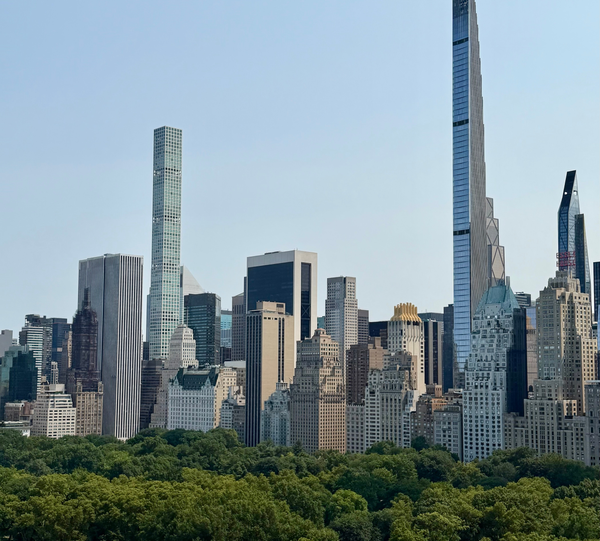
And that brings me back to New York.
The city is now wrestling with its own version of this question through the new pied-à-terre surcharge on high-value second homes. Supporters argue that owners of expensive non-primary residences should contribute more toward the city that protects and sustains the value of those properties.
I understand the argument. But I am not convinced the policy makes much economic sense.
New York has spent decades attracting people from around the world who want to own a home here, even if they do not live here full-time. Those owners buy apartments, pay property taxes and common charges, employ people, dine in restaurants, shop, attend cultural institutions and invest in the city, often while placing relatively limited demands on its public services.
Now we are effectively asking some of them to pay an additional tax simply because New York is not their primary residence.
The timing is particularly interesting. Britain is debating whether changes to its tax regime are influencing the choices of highly mobile residents, while New York is introducing a new tax aimed at a similarly mobile population.
Perhaps the greater risk is not that everyone suddenly leaves. Most will not. It is that, at the margin, the next buyer chooses Miami, Palm Beach, London, Milan or somewhere else instead.
Great cities like NY and London have enormous natural advantages.
But as San Francisco has reminded us, desirability should never be taken for granted.