
$110 Trillion. Record-Low Crime. Tightening Inventory.
I often wonder what it is about nature's display of color and symmetry that feels endlessly beautiful and uplifting. Even in the heart of Manhattan, these

Contents
I often wonder what it is about nature’s display of color and symmetry that feels endlessly beautiful and uplifting. Even in the heart of Manhattan, these small bursts of perfection adorn our sidewalks.
This week, a few very different stories caught my attention, but together they say something about where New York, wealth and real estate are today, and where may be heading.
New York’s Crime Numbers Decline
Now some really good news on the crime front:
The number of murders, among the most accurately reported of all crimes, sharply across the country in 2020, but has been declining in recent years.
In New York, the numbers are now reaching historic lows, with murders and shootings at their lowest levels on record for this point in the year.
Through the first seven months of 2026, New York City recorded 149 murders, 381 shooting incidents and 462 shooting victims — the lowest totals ever recorded for that period. Under the leadership of Police Commissioner Jessica Tisch, New York’s decline in gun violence has continued through 2026. July itself also set record lows for both murders and shootings. (Source: New York City Police Department, Aug 3, 2026)
The contrast with just a few years ago is remarkable. Nationally, the homicide rate jumped approximately 30% between 2019 and 2020, the largest one-year increase in more than a century. Since then, murders have declined substantially in many major American cities.
For a city whose perception is so often shaped by headlines, the actual numbers are worth paying attention to.
New York may be safer today than many people realize.
Everyone Has a Number

Most homeowners have a “make me move” number.
It’s the price at which staying put suddenly becomes worth reconsidering. For years, that number has been more hypothetical than realistic, reserved for conversations that begin with, “Well… if someone offered me enough.”
Recently, that theory has been put to the test in San Francisco. The city’s AI-driven boom has created extraordinary competition for desirable homes. In the first half of 2026, 144 homes sold for at least $1 million over asking, compared with just eight during the same period last year.
And increasingly, buyers are approaching homeowners who never intended to sell, with offers compelling enough to turn “not for sale” into a conversation.
Manhattan is not San Francisco, and our market has not reached that level of competition. But inventory here is beginning to tighten. Manhattan’s spring listing inventory was down approximately 15% from a year earlier, with some of the largest declines among larger apartments.
So it raises an interesting question: if inventory continues to shrink, particularly for the homes buyers want most, do we begin to see more of those “make me move” conversations here as well?
New York has always had properties that are difficult to replicate — the right view, the right building, the right combination of space, location and architecture. When one of those homes is not on the market, a determined buyer may ultimately decide that the only way to create the opportunity is to create the price.
If inventory continues to tighten, particularly for the homes buyers want most, I suspect we’ll begin to hear that question more often in Manhattan too.
The Great Wealth Transfer
One of the largest transfers of wealth in history is already underway. Much has been written about the “Great Wealth Transfer,” but the reality is more gradual than the phrase suggests.
Older Americans have accumulated an extraordinary share of the country’s wealth through decades of homeownership, rising financial markets and compounding investment returns. Today, baby boomers and older generations hold approximately $110 trillion in net wealth, compared with roughly $65 trillion held by Gen X and younger generations.
That is the story behind the first graph below: where the wealth sits today. For decades, the wealth held by older Americans has climbed dramatically, while younger generations are only now beginning to accumulate assets on a comparable scale.
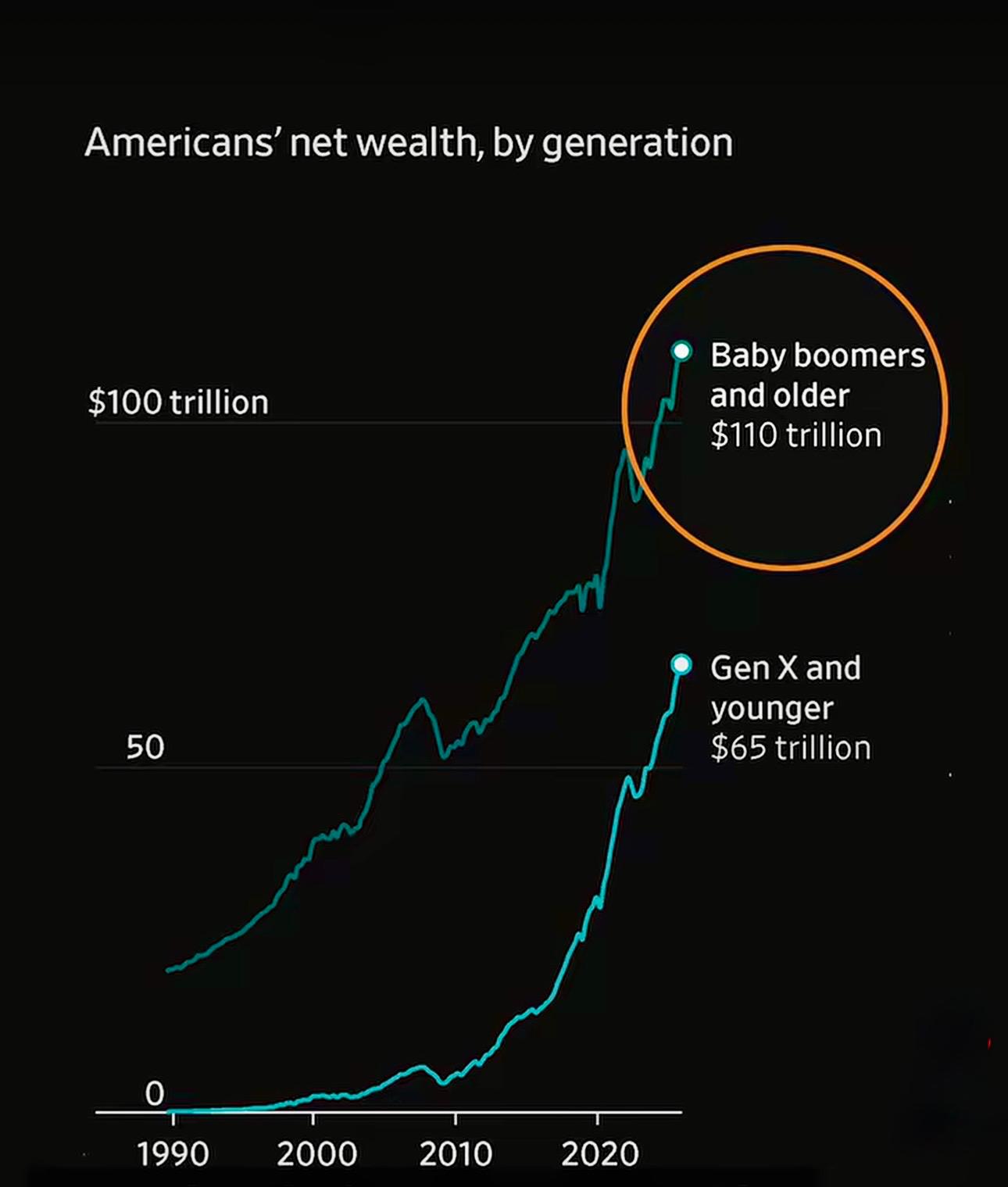
Where the wealth is today: Baby boomers and older Americans hold approximately $110 trillion in net wealth, compared with about $65 trillion held by Gen X and younger generations. (WSJ)
But those numbers are beginning to shift.
Cerulli Associates estimates that approximately $124 trillion will transfer through 2048, with about $105 trillion ultimately passing to heirs and another $18 trillion going to charities. Perhaps even more striking: more than half of that transfer is expected to come from high-net-worth and ultra-high-net-worth households, which represent only about 2% of U.S. households.
The transfer does not move evenly from one generation to another. Gen X is expected to receive the largest share first, with annual inheritances rising over the coming decade before eventually declining. Millennials follow later, with inheritance flows accelerating more sharply over time. Gen Z and younger generations begin to rise later.
In other words, the Great Wealth Transfer is not one event. It is a long generational shift that will play out over decades (graph below).
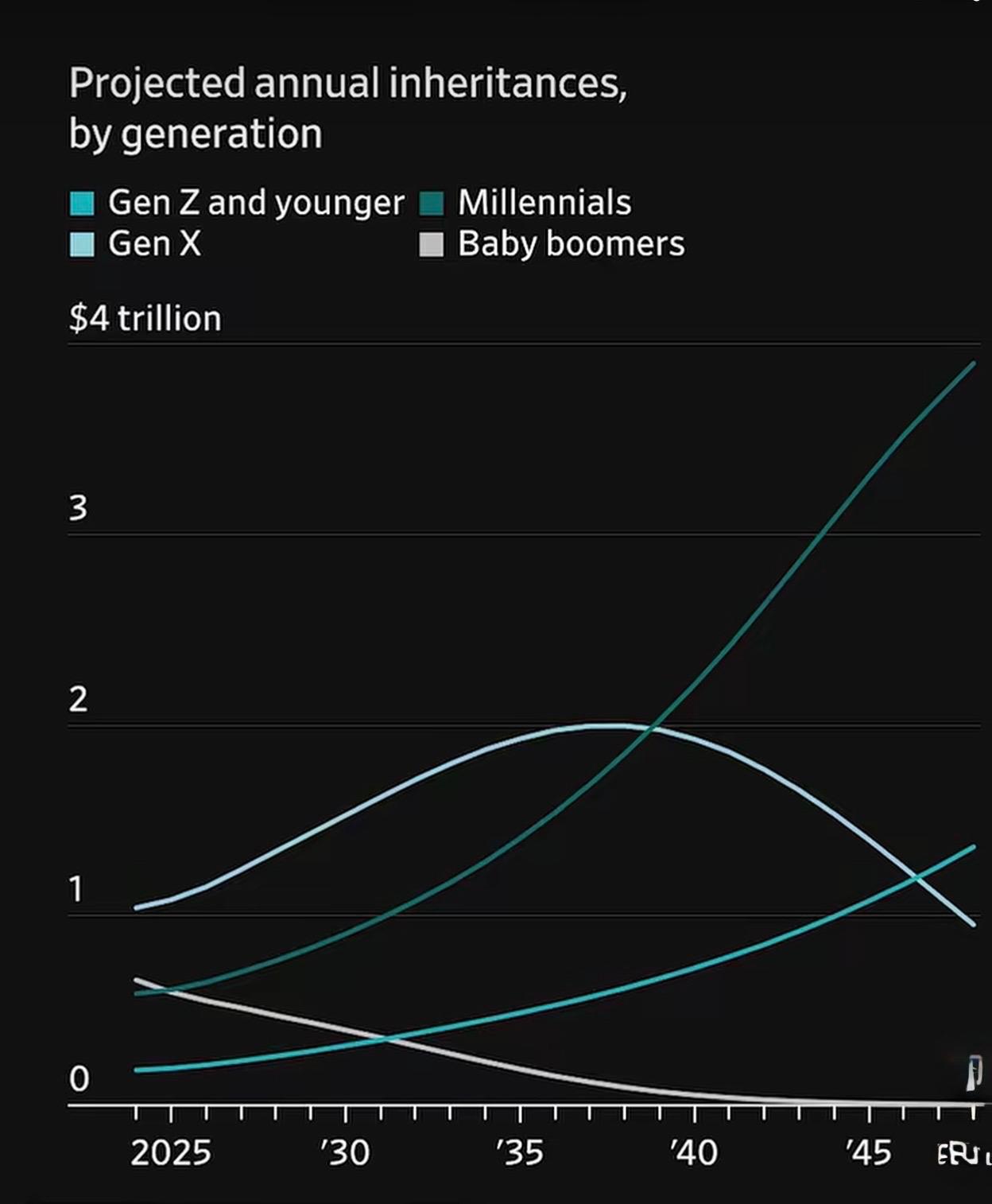
Where it is going: Gen X receives the first major wave of inheritances, but the flow to millennials accelerates dramatically over the next two decades, eventually becoming the largest annual transfer. (WSJ)
For real estate, however, the implications are already becoming significant.
This transfer will not simply appear as cash sitting in bank accounts. Some of it will arrive in the form of homes and other real estate; some will provide the capital for first or larger home purchases, second homes and investment properties.
According to research cited by The Wall Street Journal, Gen X and millennials are expected to inherit approximately $4.6 trillion in global real estate over the next decade, including $2.4 trillion in the United States.
It may also change decisions at both ends of the transaction. Older owners will increasingly make decisions about downsizing, estate planning and when to transfer property, while the next generation gains purchasing power that it did not necessarily accumulate through income alone.
The Great Wealth Transfer is often discussed as an event somewhere in the future. These graphs suggest something different: it has already begun. An enormous amount of wealth is concentrated with one generation today. Over time, both that wealth and the real estate attached to it will begin moving to the next.
The Co-op Waiting Game

For decades, the Manhattan co-op board package has been one of the most opaque parts of the buying process. Buyers could spend weeks assembling extensive financial documents, references, and disclosures, only to submit their package and wait with little clarity about what was happening behind the scenes.
That changed on July 28, 2026.
A new New York City law now establishes clearer timelines for many co-op board applications, bringing greater structure and accountability to the approval process. Once an application is submitted, the Co-op has 15 days to acknowledge receipt and identify any missing documents. If they fail to do so, the package is legally considered complete.
From that point, the co-op generally has 45 days to approve, conditionally approve or deny the application. The deadline may be extended once, by up to 14 additional days without the purchaser’s consent, and violations can result in financial penalties. The law generally applies to co-op buildings with 10 or more residential units.
There are some important nuances. Buildings that formally observe a summer recess may pause the clock during that period, and boards are still not required to explain a denial.
The result is a more defined process, but preparation remains everything. In Manhattan’s co-op market, a well-organized, thoughtfully prepared board package can make all the difference.
For buyers and sellers, however, the important change is simple: a process that could once feel indefinite now has a clearer timetable.
And in a Manhattan co-op transaction, a little more certainty is a very welcome thing.