
New York City Is Outrunning America
Scott Galloway and Adam Gopnik reflect on New York's extraordinary moment, plus the hidden history of the city's rooftop water towers and a $25M SoHo penthouse.
Contents
Last week, on a walk with a friend, we paused to take in the late-summer serenity of the Burnett Fountain in Central Park’s Conservatory Garden, inspired by Frances Hodgson Burnett’s The Secret Garden.
Are We Living Through New York’s Golden Age?
Scott Galloway and Adam Gopnik on New York’s extraordinary moment
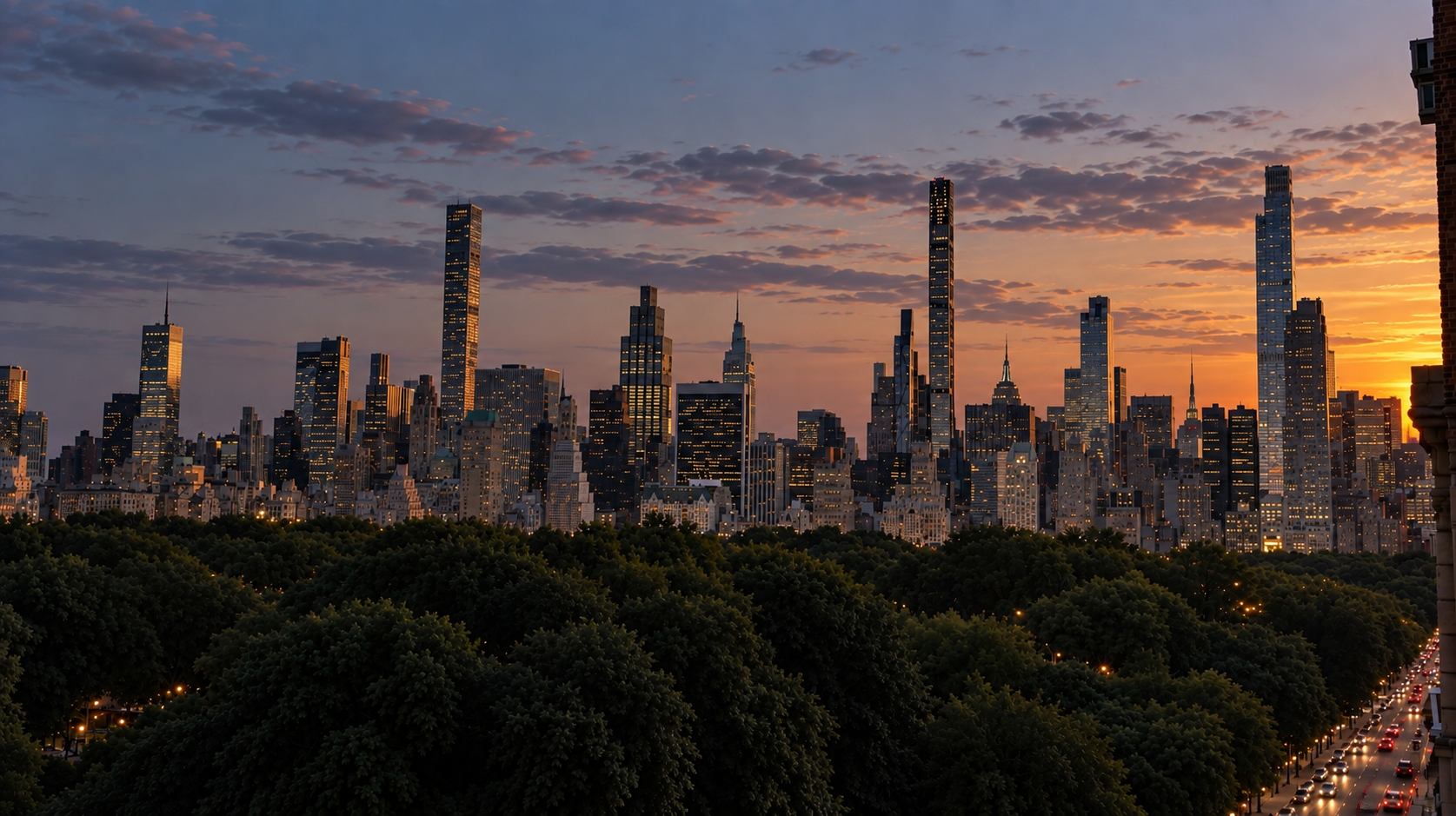
Manhattan at dusk: the Midtown skyline with Central Park in the foreground, photographed from my listing on Central Park West.
Twice this week, I came across two very different reflections on New York from people whose observations I always find worth listening to.
The first was a social media post from an exuberant Scott Galloway, entrepreneur, NYU professor and commentator, standing on a crowded corner of SoHo on a Saturday and taking in the sheer energy around him.
The second was from Adam Gopnik, the longtime New Yorker writer and essayist, in PBS’s New York: A Documentary Film.
First, Scott Galloway, whose post caption was unequivocal: “New York City is outrunning America.”
He goes on:
“I’m in the Disneyland of a capitalist economy; that is, I’m in New York on a Saturday. And it is nothing short of breathtaking and inspiring.
People are not at home plotting how they can kill humanity with their new Claude Pro, not gambling on interest rates. They are out with each other, their friends, their family, tourists. [They are] just having an unbelievable time. My God, this is insane.”
That’s often how I feel as I zip around this incredible city every day, fortunate to call it home.
Galloway asserts that we may be living through New York’s Golden Age.
“Since 2010, New York isn’t evolving. It’s outrunning everybody.”
Here are the data points he cites:
Since 2010, New York City’s share of New York State’s GDP has risen from roughly 54% to 60%.
Since 2020, the region has added 1.1 million jobs.
Some 65 million visitors came to New York last year, generating approximately $85 billion in economic activity and supporting roughly 400,000 jobs.
Broadway attendance now exceeds the combined attendance of New York’s major professional sports teams.
This is nothing short of staggering and inspiring.
His point is not that New York is without problems. He also acknowledges the city’s high cost of living, inflation and the uneven way prosperity is being shared.
But his larger argument is that New York is not simply recovering or holding its own. It is thriving in ways that may only become fully apparent in hindsight.
As Galloway puts it, we rarely recognize a golden age while we are living through it. Perhaps, he suggests, “in 2046, we’re going to look back in New York and think, that [this] was a golden age.”
He ends simply: “Unbelievable.”
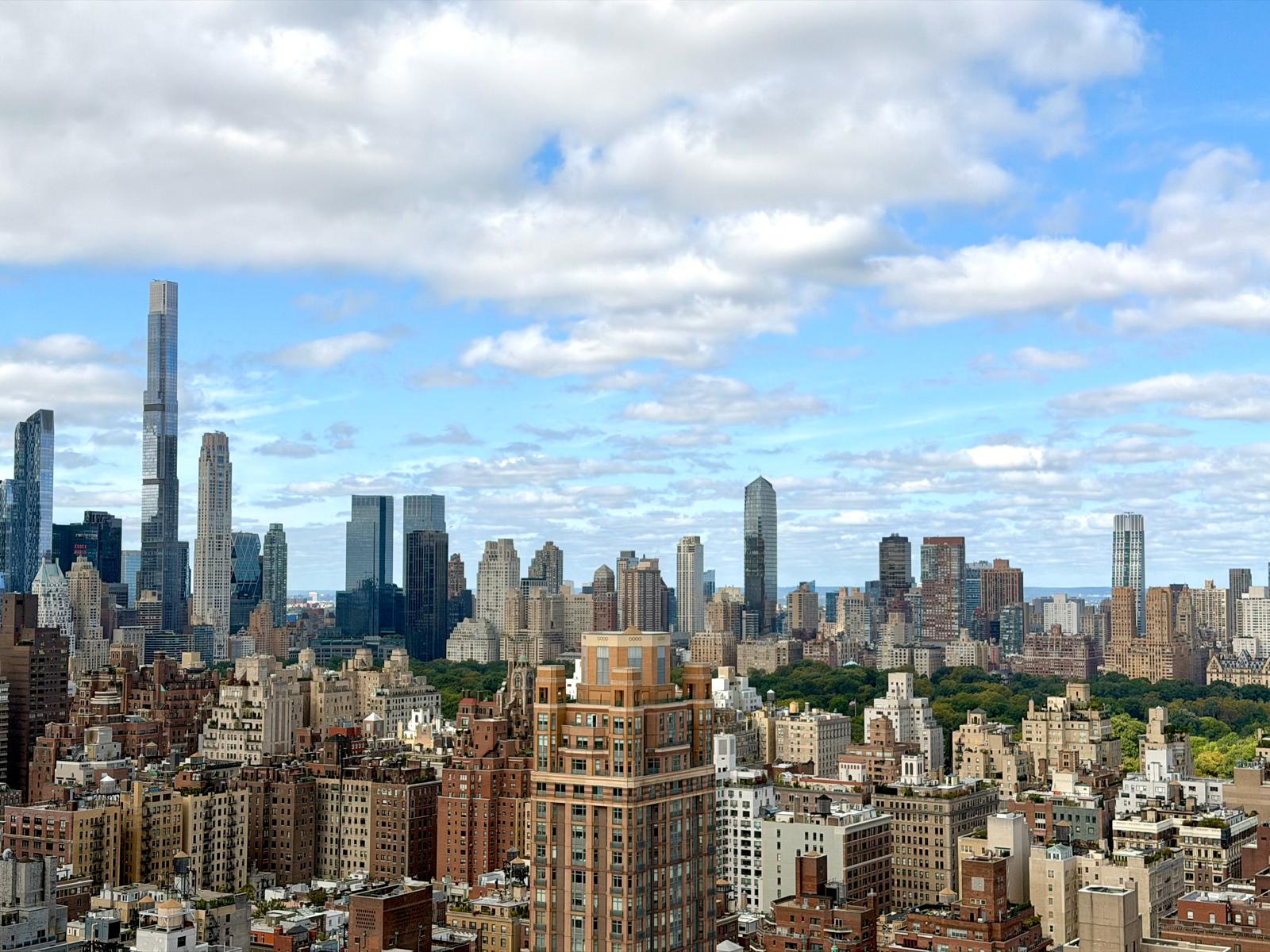
A view of the city from the Penthouse of Naftali’s exquisite new condo development at 255 East 77th Street.
And then, almost on cue, I came across another reflection on New York, this time from writer Adam Gopnik in the new PBS continuation of New York: A Documentary Film.
Gopnik’s perspective is different. His is less about the exuberance of the present moment and more about something deeply embedded in New York’s character: its extraordinary ability to recover and reinvent itself.
He reflects on the many blows the city has absorbed over the decades, from the crime waves of the 1960s and ’70s to September 11, and how persistently New York has found its way back.
As he puts it:
“The city has rebounded again and again and again from things that seem to be utterly fatal blows.”
And then this line, which especially stayed with me:
“Scars are better than wounds. And New Yorkers’ wounds tend to heal remarkably quickly.”
Gopnik goes even further:
“You know, cities, more than anything else on earth, more than coral reefs, more than forests, more than anything else, are self-emerging and self-sustaining forms. And no place…
I say this as a big statement, but I say it with confidence.
No place in the history of the earth has remade itself more resiliently, more persistently than this, than this small stretch of city.”
Source: PBS, New York: A Documentary Film, “Shadows of the Past.”
Perhaps Galloway and Gopnik, from very different angles, are describing the same thing.
One sees the extraordinary energy of New York right now. The other sees its extraordinary ability to endure.
New York has an almost unmatched capacity not simply to survive, but to renew itself.
And perhaps that is what makes the idea of a new golden age feel not entirely far-fetched.
New York’s Other Skyline
The Wooden Hiding in Plain Sight Above the City
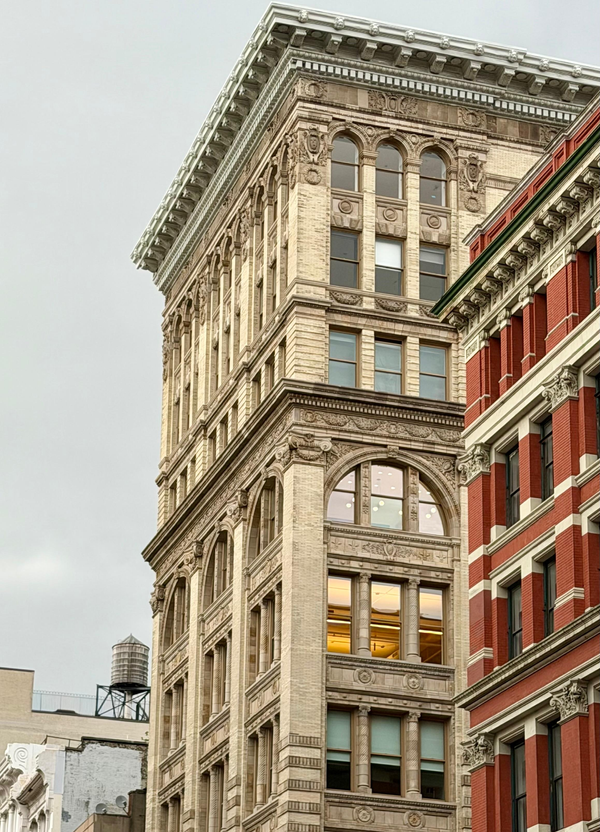
In SoHo, looking up past the neighborhood’s gorgeous cast-iron loft buildings, one of New York’s ubiquitous wooden water towers punctuates the skyline.
Look up almost anywhere in Manhattan and you’ll see them: those wonderfully old-fashioned wooden water towers perched on many rooftops, often surrounded by some of the most modern architecture in the world.
I come across them often as I tour rooftops with clients and I’ve always found them intriguing as a distinctly NYC skyline feature. Many clients do too. So I decided I should learn a little more about their history.
There are more than 5,600 water tanks across New York City, and their continued existence is a wonderfully practical story of engineering. City water pressure historically could carry water only to about the sixth floor. As New York began building higher in the late 19th century, water had to be pumped to tanks on the roof and then distributed downward through the building by gravity.
What I love is how little the basic technology has changed.
Many of the tanks are still made from cedar or redwood, assembled much like enormous wooden barrels. The wood swells when filled with water, creating a naturally watertight vessel, and it also provides insulation against New York’s hot summers and freezing winters. A typical tank can hold thousands of gallons of water and may last 25 to 30 years before being replaced.
They have become such an intrinsic part of the New York skyline that artists have been drawn to them for generations. Edward Hopper and John Sloan painted them. Bernd and Hilla Becher photographed them as what they called “anonymous sculpture.” And in 1998, artist Rachel Whiteread created a translucent resin Water Tower for a SoHo rooftop, a work that later entered MoMA’s collection.
In a city obsessed with what is new and next, I find it rather wonderful that one of the most recognizable elements of our skyline is still doing essentially the same job it was designed to do more than a century ago.
A little piece of 19th-century engineering, still quietly working above us every day.
Thierry Henry’s Garden Oasis Above SoHo
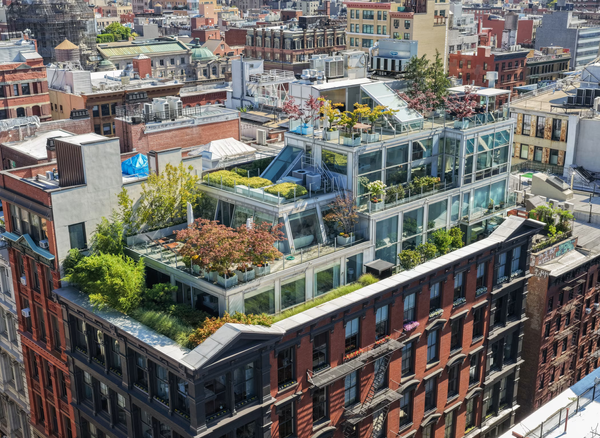
In this city, some of the most extraordinary homes, and gardens, are hidden high above the streets.
That is certainly true of Thierry Henry’s SoHo penthouse, now back on the market for $25 million.
The approximately 6,000-square-foot residence includes roughly 3,400 square feet of private outdoor space, with terraces and a rooftop garden perched above one of downtown’s most iconic neighborhoods.
From several rooms of the penthouse, you see one of the most quintessentially New York skyline features: wooden water towers rising above the surrounding rooftops. It is such distinctly New York living. Even in a sleek, expansive contemporary penthouse, the view still carries the layered texture of the old city, cast-iron buildings, rooftop tanks and all.
Henry and his partner, Andrea Rajacic, created the home by combining the penthouse with the apartment beneath it after purchasing the properties in 2010. The result is a sprawling downtown residence with soaring ceilings, walls of glass and expansive outdoor space.
What strikes me most is the contrast: the cobblestone streets, cast-iron buildings and bustle of SoHo below, and then, several stories above, this private world of trees, terraces and sky.
One of the great pleasures of New York real estate is that some of its most remarkable spaces are the ones you would never know existed from the street.
See It First
In a market where the best homes can attract attention quickly, timing matters.
Compass has introduced See It First, giving buyers access to certain Compass listings before they appear on the broader market.
For buyers, that can mean an earlier look at homes that may never feel truly “new” by the time they reach the major real estate portals.
For sellers, it creates another way to build early interest and test demand before a wider launch.
For my clients, the practical point is simple: the more connected you are to what is coming, the better positioned you are to act when the right property appears.
My newest listing at 470 Park Avenue, a gorgeous PreWar home in a white glove Co-op with almost 40 feet of Park Avenue frontage is showcased as a See it First.
See it First: 470 Park Avenue
$1,595,000 | Magnificent PreWar
My newest listing at 470 Park Avenue, a gorgeous PreWar home in a white glove Co-op with almost 40 feet of Park Avenue frontage is now being showcased as a See it First.